

 Contact Us

 Home /
 Suction Cup Layout for Flexible Sheets: Sag, Local Stress, and Controlled Release
Delivery Robot Accessibility: Tray Reach, Controls, and Assisted Handoffs
Oct 12, 2026
Commercial Carpet-Vacuuming Robots: Pile, Edge Transitions, and Maintenance Limits
Oct 12, 2026
Robotic TIG Filler-Wire Delivery: Feed Angle, Arc Access, and Stop-Start Quality
Oct 12, 2026
Suction Cup Layout for Flexible Sheets: Sag, Local Stress, and Controlled Release
Oct 12, 2026
Two grippers with the same total suction force can handle a flexible sheet very differently. The difference is where the contact points sit, how much of the sheet is left unsupported between them, and how the force is removed when the sheet is released. For rigid parts, total force is a reasonable starting point. For thin, flexible sheets, the layout is what determines whether the part arrives flat, dented, or dropped.
Define the Sheet as a Flexible Load
A flexible sheet is not a rigid block, and the first step is to describe it as the load it is.
Record the material, its thickness, and its stiffness. Note the support length, meaning the largest unsupported span the sheet can have before it sags or buckles. Record any coating or surface condition that limits where a cup may touch. Record the deformation the part can tolerate: some sheets may bow slightly and recover, others may take a permanent set or show marks.
These properties come from the sheet supplier's data and from the part's own requirements, not from a general assumption about “thin material.” A sheet that behaves like a flexible membrane in one orientation may be relatively stiff in another, depending on how it is rolled or textured. Describe the part as a load with specific limits, and those limits become the constraints the layout must respect.
Map Available Contact Areas
Before choosing how many cups and where, find out where a cup is actually allowed to touch. If the contact principle itself has not yet been selected, start with the broader robot gripper selection guide before specifying cup positions.
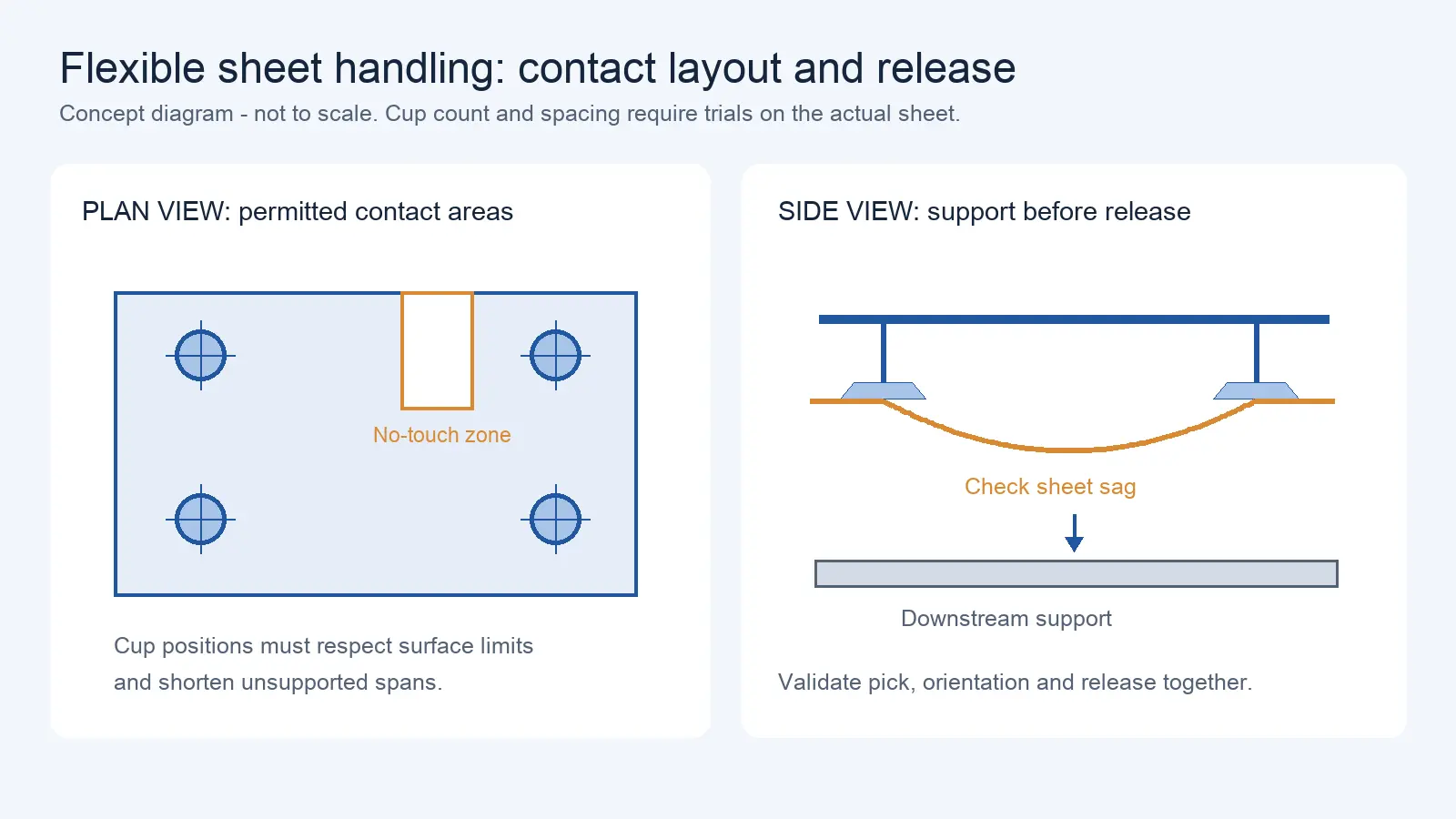
Mark the sheet's geometry and identify the zones a cup cannot use: holes, cut-outs, protected or coated faces, edges that must stay clean, and areas that flex too much to hold reliably. Then mark the zones a cup can use, and note the center of mass of the sheet. An asymmetric part needs its contacts arranged around the center of mass, or it will tilt as soon as it is lifted.
This map is a drawing, not a rule. It shows the available contact points and the forbidden ones, and it makes the next decision, how many cups and at what spacing, a real engineering choice rather than a guess. The map also reveals conflicts early: a part whose stiffest area is also a no-touch zone forces a different solution, such as a support that reaches under the sheet instead of gripping its face.
Compare Cup Count, Spacing, and Compliance
With the contact map in hand, the design compares how force is distributed across the sheet.
Position additional supports to shorten unsupported spans and reduce sag. Select the layout for the sheet stiffness, contact deformation, and load-sharing conditions. Adding contact points can reduce the average load per point if total load and acceleration are held constant, but local pressure and marking still depend on cup area, vacuum level, mount compliance, geometry, and unequal load sharing. Spacing sets the support pattern: contacts spread evenly under a flexible sheet keep it flatter than contacts clustered in the middle. Compliance, the ability of a cup or mount to move vertically, lets the sheet settle into a natural shape instead of being forced flat, which reduces both sag and local stress.
Bernoulli-type non-contact lifters and sealing suction cups use different airflow and contact mechanisms. Research on flexible-substrate deformation can motivate checking deflection and force distribution in both systems, but its measured lift forces, spacing, and stability cannot be transferred between mechanisms without separate testing. That research is mostly on specific materials such as wafers and food products, so treat it as a description of the principle rather than a formula for your sheet. SMC China lists a Bernoulli-type ZNC pad for thin cloth, film, and circuit boards, but states that contact may occur with flexible materials or when positioning accessories are fitted. Its SP perforated vacuum plate is a separate surface-suction product; do not describe it as a non-contact Bernoulli lifter or transfer its deformation claims to every sheet. The specific number of cups, their spacing, and their compliance belong to the tool engineering task, verified on the actual part. Do not apply a universal cup count or spacing rule.
Check Orientation Changes and Airflow
Lifting a sheet is a gravity problem. Turning it over adds bending and airflow, which is a different problem.
When a sheet is rotated, the force that held it against gravity now has to hold it against a changing direction, and the part's own weight can cause it to sag or swing in the new orientation. Airflow matters twice here. Air flowing under the sheet can add an aerodynamic force that complicates the hold, and airflow into an adjacent sheet can cause the next part in a stack to be picked up along with the intended one. That last effect is a stack-handling problem, and it is one reason a gripper that works on a single sheet can fail on a stack.
Test the pick in the orientations the cycle actually uses, not just the flat pick. Note whether the sheet sags in the new orientation and whether neighboring sheets move. Total suction force alone does not tell you whether a flexible sheet stays intact through a flip, because the load on the sheet changes during the move.
Control Release onto the Next Support
A gripper that can pick a sheet has not been proven to place it. Release is where flexible parts are most often lost or damaged.
How the suction is released matters. A single release drops the whole sheet at once, which is fast but can let it flex and settle unevenly. A sequenced release, breaking contacts in a planned order, lets the sheet settle onto its support progressively. The drop height matters too: a larger gap lets the sheet fall and possibly slide or bounce, while a contact release depends on the support being positioned accurately first.
Design the release for the next support, not just for the pick. Where will the sheet rest, and how is it aligned there? What is the acceptable placement tolerance, and how much variation can the support absorb? Compare release approaches against those requirements, and test them on the actual downstream support. A tool that picks perfectly but releases badly will still damage parts, so treat release and pick as two halves of one trial.
Create a Sheet-Handling Trial
The evaluation ends with a trial that uses the worst sheets, not the typical one.
Select the sheets that stress the design: the thinnest, the largest, the most warped, and the one whose stiff areas conflict most with its no-touch zones. Run them through the full pick, move, orient, and place cycle, and inspect the result for appearance, deformation, and placement quality. Photograph the contacts and the sheet's shape after release.
Record the conditions of each trial: the sheet, the cup configuration, the release method, and the support. That record becomes the evidence for which cases the design covers and which remain open. Where a sheet fails, the failure tells you which constraint was violated, which is more useful than a pass on a part that was never the problem.
Share a marked sheet drawing showing allowed contact zones, the material and thickness range, maximum acceptable sag and surface marks, and the downstream placement requirement. AIsirRobot can help organize a preliminary application assessment and the questions needed for tool suppliers.
Share on Social:


Contact Us
In This Article
Delivery Robot Accessibility: Tray Reach, Controls, and Assisted Handoffs
Oct 12, 2026
Commercial Carpet-Vacuuming Robots: Pile, Edge Transitions, and Maintenance Limits
Oct 12, 2026
Robotic TIG Filler-Wire Delivery: Feed Angle, Arc Access, and Stop-Start Quality
Oct 12, 2026
Suction Cup Layout for Flexible Sheets: Sag, Local Stress, and Controlled Release
Oct 12, 2026