

 Contact Us

 Home /
 Commercial Carpet-Vacuuming Robots: Pile, Edge Transitions, and Maintenance Limits
Delivery Robot Accessibility: Tray Reach, Controls, and Assisted Handoffs
Oct 12, 2026
Commercial Carpet-Vacuuming Robots: Pile, Edge Transitions, and Maintenance Limits
Oct 12, 2026
Robotic TIG Filler-Wire Delivery: Feed Angle, Arc Access, and Stop-Start Quality
Oct 12, 2026
Suction Cup Layout for Flexible Sheets: Sag, Local Stress, and Controlled Release
Oct 12, 2026
A robot vacuum that handles hard floors well can still disappoint on carpet, and the reason is not usually navigation. Carpet is a different surface with a structure of its own: a pile of fibers, a backing, a pad or no pad, seams, and edges. A machine that vacuums a flat floor competently may struggle to make contact with the pile, to move across transitions, or to reach under furniture. Before a site buys a carpet-capable robot, it has to decide what cleaning method the carpet actually needs and whether the machine is built for it.
Define the Cleaning Method Required
Carpet cleaning covers several different jobs, and a robot vacuum does only some of them.
The wider distinctions among sweeping, wet scrubbing and vacuuming are covered in our commercial cleaning robot modes guide.
Daily vacuuming removes loose soil from the surface of the pile. Spot cleaning removes a specific stain or mark. Hot-water extraction, shampooing, encapsulation, and other methods are distinct carpet-cleaning processes with different equipment and procedures. A dry-vacuuming robot should be assessed for its assigned routine vacuuming task, not assumed to replace periodic extraction or stain-treatment work. Dry methods use compounds or pads to clean without a wet extraction step. These are different methods with different equipment, and a robot vacuum is a surface-cleaning machine, not an extraction machine.
Decide which job the robot is being asked to do. If the site needs deep extraction on a schedule, that is a separate service or a separate machine, and the robot's role is the routine surface vacuuming in between. Mixing the jobs leads to a machine judged against a standard it was never designed to meet. State the cleaning responsibility clearly: surface vacuuming on the covered zones, with deep extraction and stain treatment handled by other means.
Document Carpet Construction and Condition
Carpet is not one material, and the machine's fit depends on what the carpet is made of and what condition it is in.
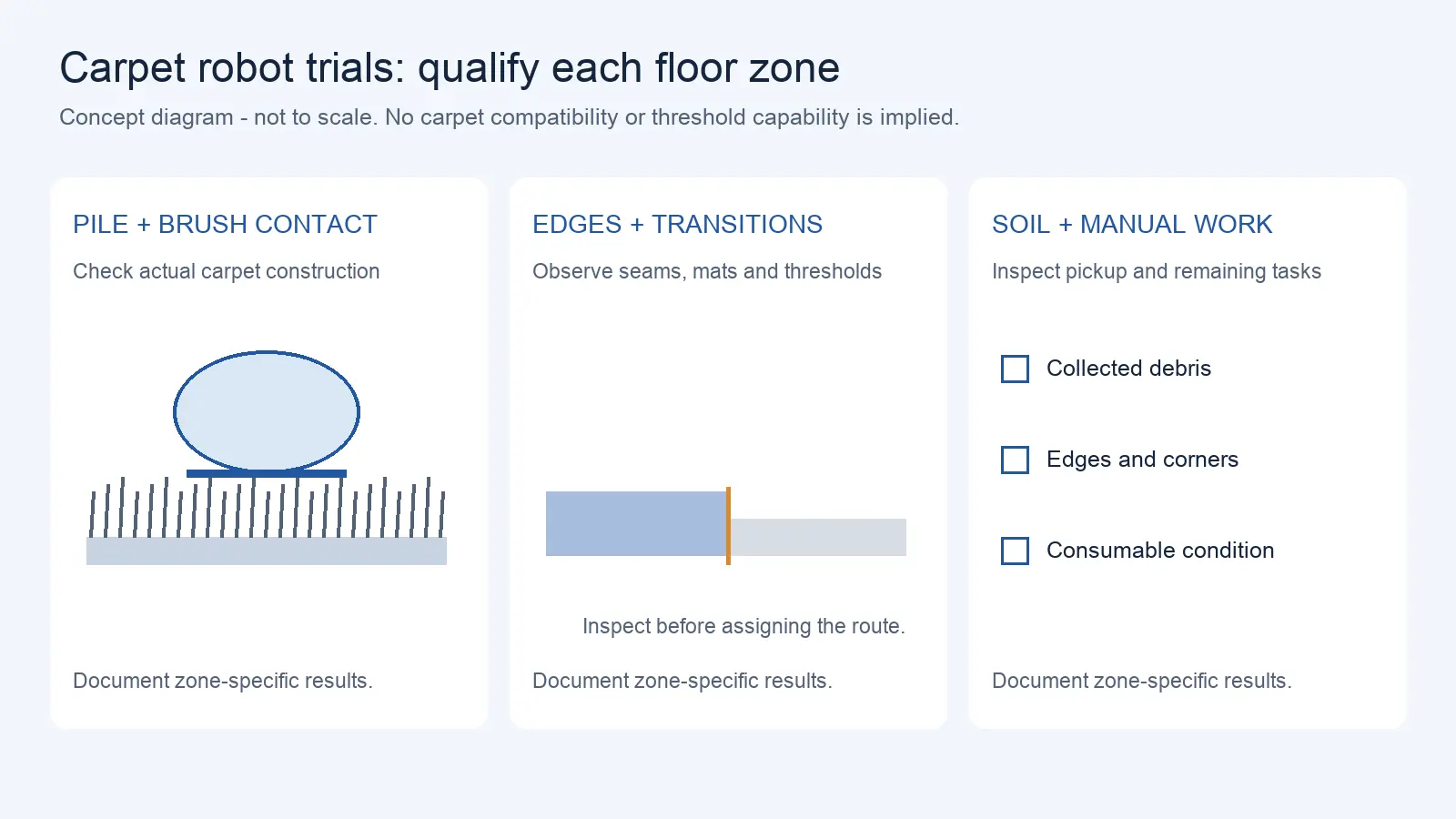
Record the pile type: loop pile, where the fibers loop back into the backing, cut pile, where the fiber ends are exposed, or a mix. Record the pile height, because surface vacuuming contact changes with pile length. Note whether there is a pad under the carpet, and the carpet's backing. Note the condition: worn traffic lanes, loose edges, ripples, and carpet tiles with seams between them. Loose edges and ripples can catch on a machine's brush or wheels.
The IICRC, a certification body for the cleaning and restoration industry, publishes standards for professional cleaning of textile floor coverings that address fiber and construction types, which is the kind of reference that frames how carpet is described. That framing is useful, but it describes carpet for cleaning professionals; it does not tell you whether a given machine fits your carpet, so turn it into specific questions for the supplier: which fiber and construction types did you test this machine on, what pile height range is covered, and what does the machine do at the edge of that range? Your own survey should record the specific construction and condition of each zone, because two carpets that look similar can behave differently under a machine.
Test Brush Contact and Mobility
Whether the robot cleans carpet depends on whether its cleaning mechanism reaches the pile and whether it can move across the surface.
Check the machine's cleaning mechanism: a rotating brush, a beater bar, or suction alone. A brush has to contact the pile to agitate soil loose, which means the brush height or the machine's weight distribution matters on carpet. Too little contact and the brush skips over the pile; too much drag and the machine stalls or the brush catches a loop.
Mobility on carpet is a separate check. Pile adds rolling resistance and can change traction compared with a hard floor. Transitions between carpet and hard floor, or between pile heights, change the resistance suddenly. Test the machine's movement on the actual carpets, including the thickest and the loosest, and observe whether it maintains contact and speed. Where a manufacturer does not publish pile-height limits or carpet suitability data, the test belongs on your floor. Do not assume a machine that is marketed for carpet covers all pile types or heights.
Inspect Edges, Transitions, and Under-Furniture Access
Carpet is rarely a clean rectangle. The places where it changes, ends, or meets furniture are where the robot's coverage stops.
Carpet edges at walls, and transitions at doorways, thresholds, and changes of flooring, are the boundaries of the machine's zone. A robot may not be able to cross a raised threshold, or may lose contact at an edge. Carpet seams and tile gaps can catch wheels, and a loose edge can be pulled up by a brush.
Under furniture is another limit. A robot that navigates by a sensor strip or a camera may not see under a sofa or a low table, and its height may keep it out of spaces a wand or a handheld vacuum could reach. Map these boundaries before deployment and decide which areas the robot covers and which stay manual. This is a task-boundary exercise: for each zone, mark whether the robot can enter, clean the surface, and leave, and where it cannot, assign the area to manual cleaning.
For portfolios of facilities with different flooring, see multi-site cleaning robot specifications before generalizing one zone’s result.
Measure Collection and Remaining Manual Work
The meaningful measure of a carpet robot is not route coverage but how much soil it collects and how much manual work remains.
Collection is what the machine actually removed: the contents of its dust container, weighed or observed across a known area. To compare robot and manual vacuuming, use matched test zones or a controlled, repeatable soil-loading and cleaning procedure; sequential passes over the same patch do not provide equivalent starting conditions. A coverage map alone does not prove soil removal. Evaluate collection together with the starting soil condition, test method, repeat passes, and remaining cleaning requirements.
Remaining manual work is the other half. After the robot runs, what still needs a person: edges, under-furniture zones, transitions, stains, and the spot where the machine could not reach. Time the robot's effective cleaning against the manual work it leaves. Coverage percentages and theoretical area rates are less useful than the observed collection and the measured manual follow-up, because they do not reflect how much the machine actually removed from the pile.
Build a Carpet-Zone Qualification Sheet
The output is a zone-by-zone statement of what the robot may clean and under what conditions, not a general claim that the machine handles carpet.
For each carpet zone, record the pile type and height, the condition, the machine's ability to clean it, the consumables or maintenance it needs, and the areas the robot must not enter or cannot reach. Include a recheck condition: what state the carpet must be in for the robot to be assigned the zone, and when a person must take over. A worn edge or a loose seam is a recheck trigger, not a permanent pass.
Map pile types against cleaning responsibility and pass or not-fit conditions, and keep the sheet current as carpets age and change. Do not extend one zone's result to another carpet without checking, and do not make claims about bacteria, dust mites, or deep-cleaning effect: those are separate methods with separate evidence, and a surface vacuum is not a deep clean.
Build a zone list with carpet construction, pile height, edge condition, transitions, manual follow-up and any observed debris collection. AIsirRobot can use those inputs to help compare available machines and unresolved supplier specifications through robot selection support.
Share on Social:


Contact Us
In This Article
Delivery Robot Accessibility: Tray Reach, Controls, and Assisted Handoffs
Oct 12, 2026
Commercial Carpet-Vacuuming Robots: Pile, Edge Transitions, and Maintenance Limits
Oct 12, 2026
Robotic TIG Filler-Wire Delivery: Feed Angle, Arc Access, and Stop-Start Quality
Oct 12, 2026
Suction Cup Layout for Flexible Sheets: Sag, Local Stress, and Controlled Release
Oct 12, 2026