

 Contact Us

 Home /
 Autonomous Forklift Buying Guide: Pallets, Load Center, Lift Height, Aisles, Docking, and Safety
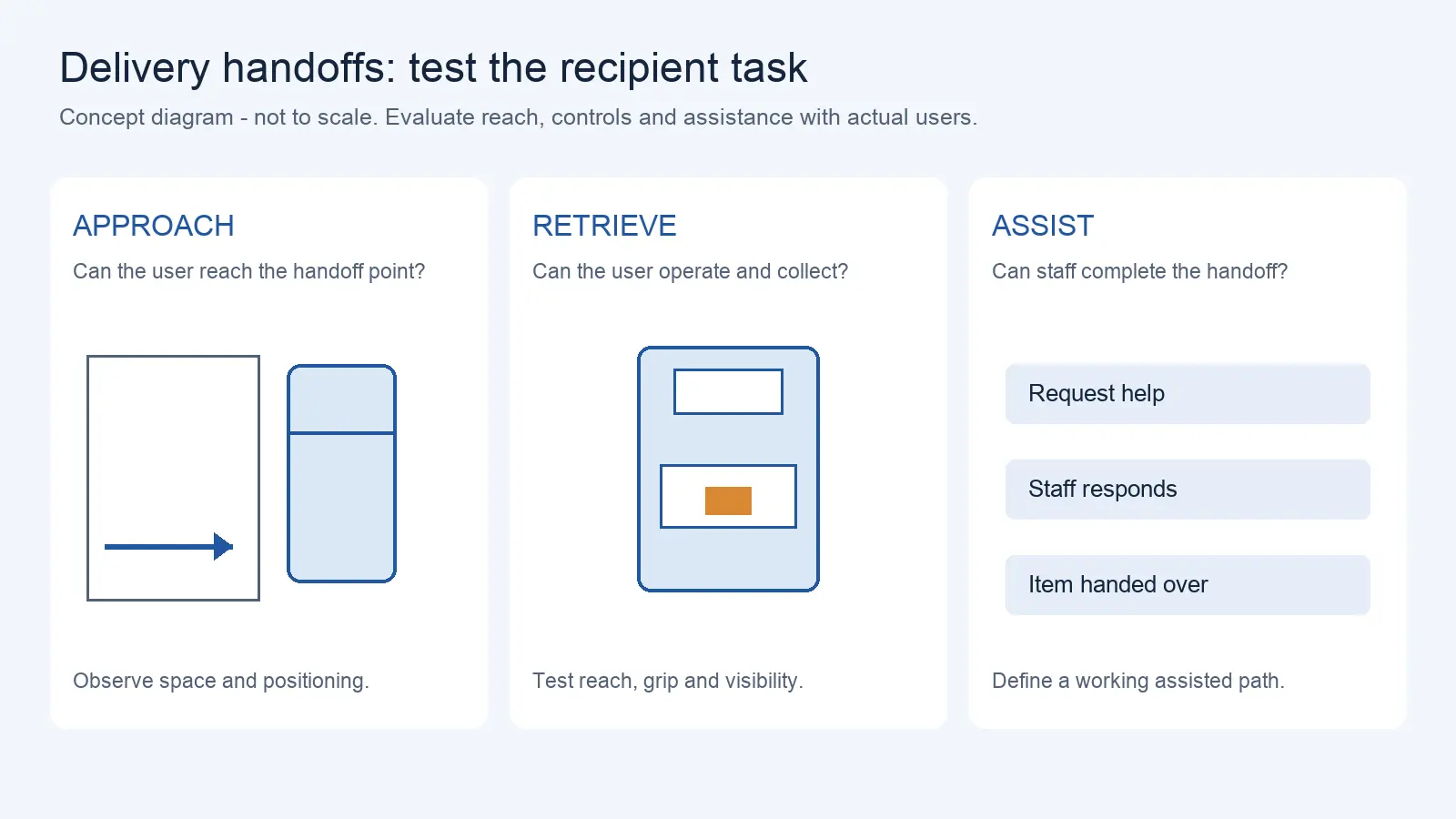
Delivery Robot Accessibility: Tray Reach, Controls, and Assisted Handoffs
Oct 12, 2026
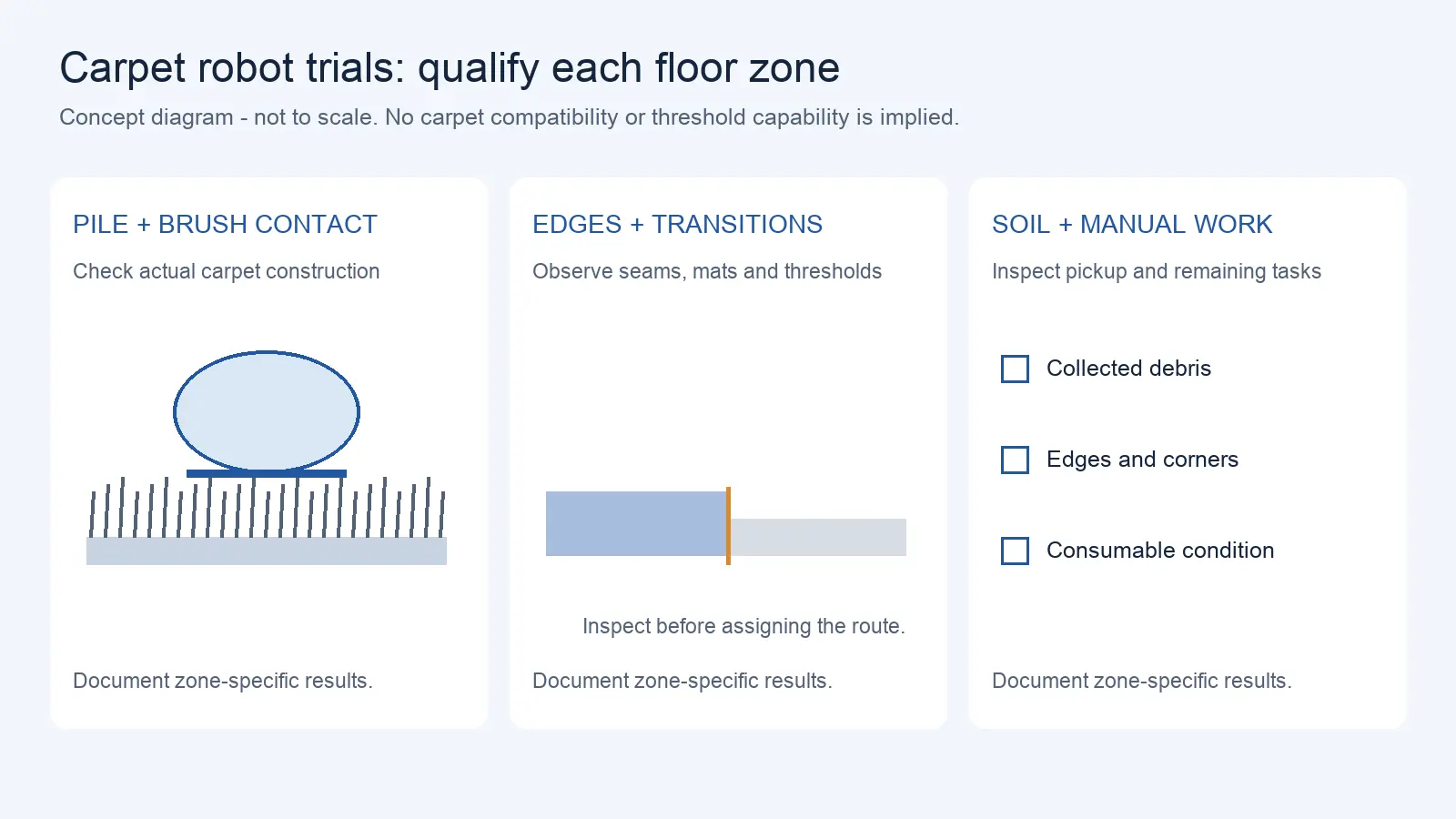
Commercial Carpet-Vacuuming Robots: Pile, Edge Transitions, and Maintenance Limits
Oct 12, 2026
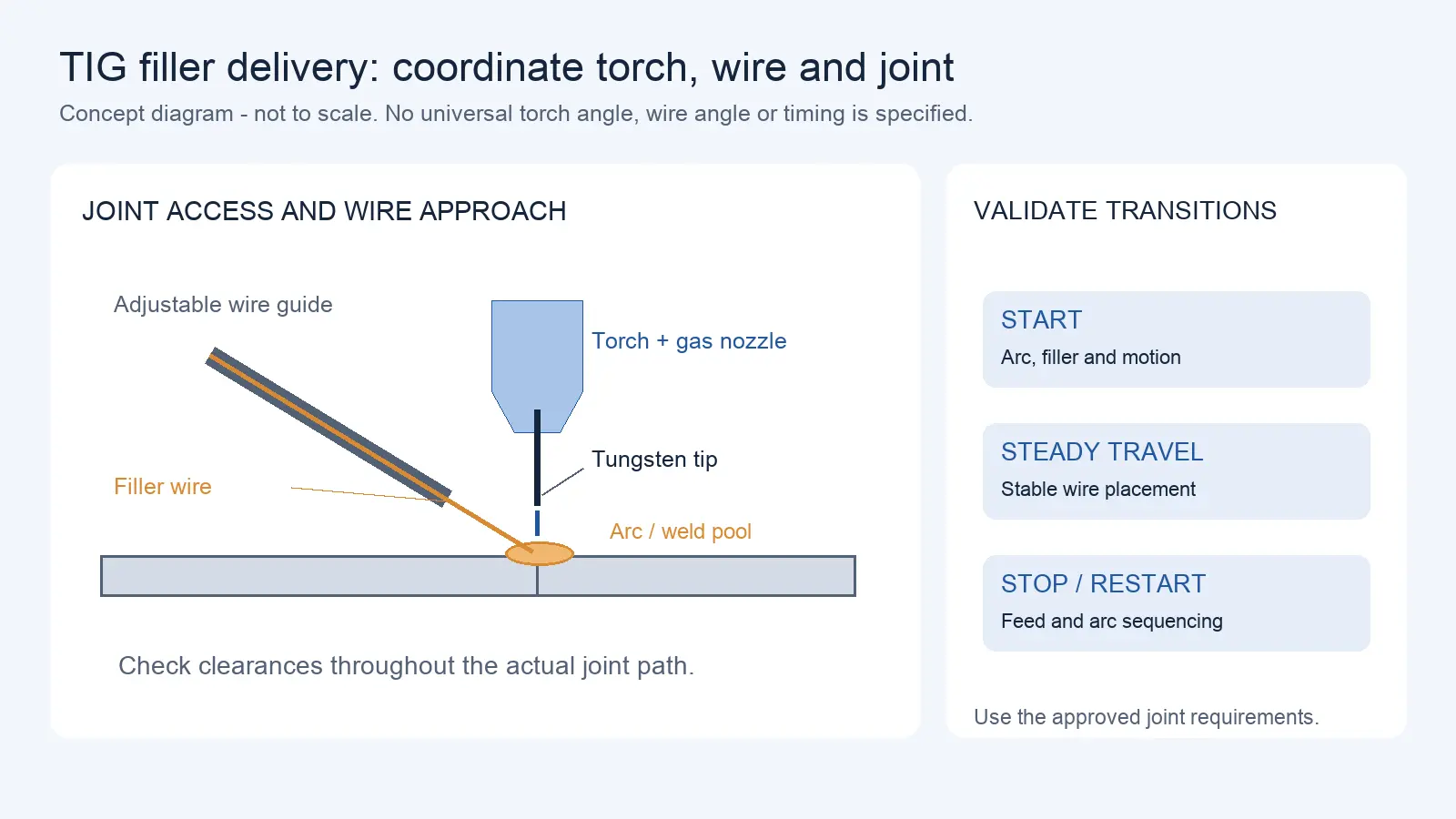
Robotic TIG Filler-Wire Delivery: Feed Angle, Arc Access, and Stop-Start Quality
Oct 12, 2026
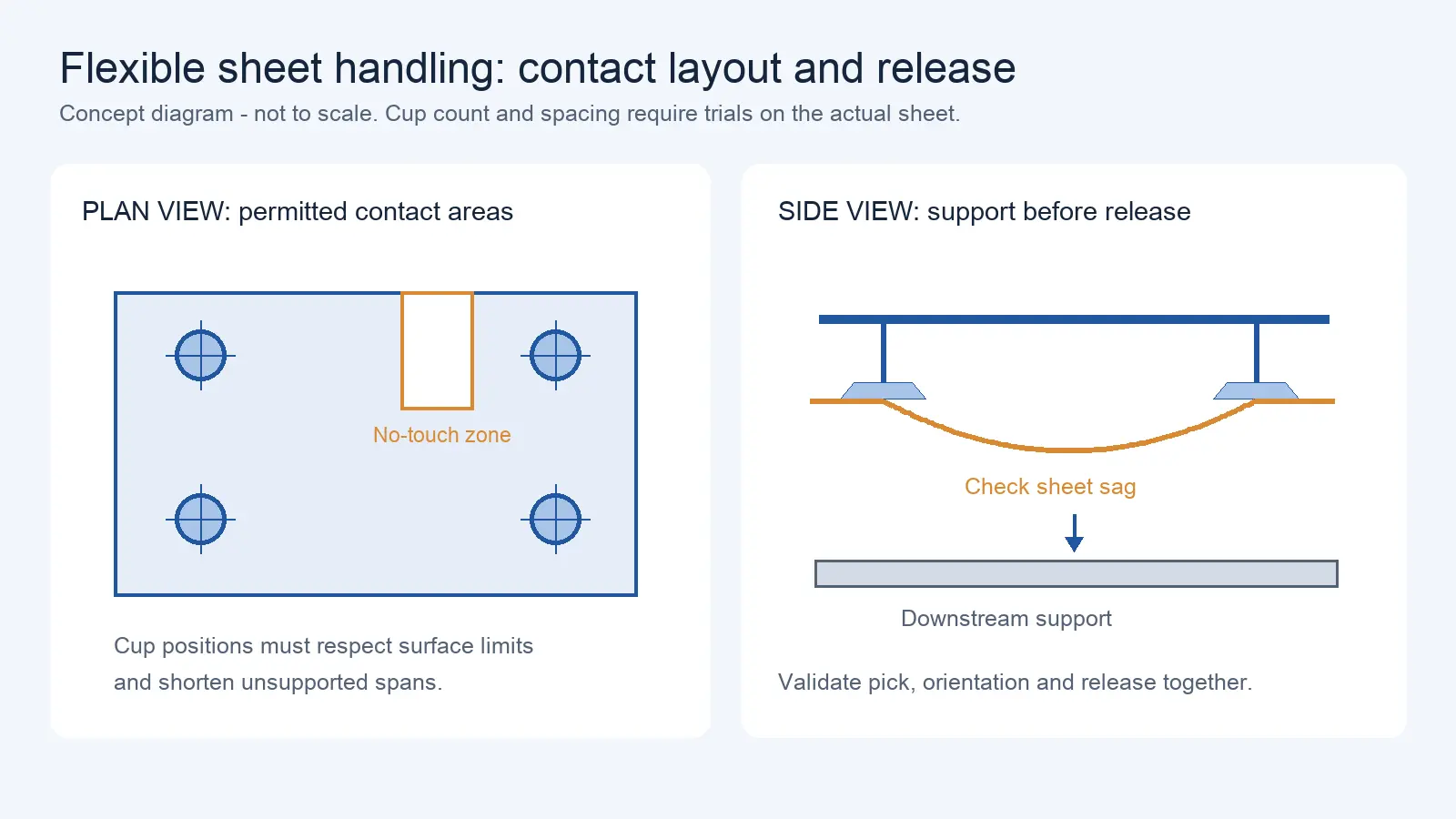
Suction Cup Layout for Flexible Sheets: Sag, Local Stress, and Controlled Release
Oct 12, 2026
An autonomous forklift is not a forklift that drives itself to a pallet and picks it up. It is a system that depends on pallet type, load center, floor geometry, aisle dimensions, docking precision, safety zones, and software interfaces to function. Most buying mistakes happen before a single model is compared — when the site survey is incomplete, the pallet data is assumed instead of measured, or the WMS integration is treated as an afterthought. This guide breaks down what to measure, what to specify, and what to verify before sending an RFQ.
The single most common mistake in autonomous forklift procurement is starting with navigation technology. Buyers ask “LiDAR or vision?” or “AGV or AMR?” before they have answered a more basic question: what pallet are we picking up, and how heavy is it?
There is no single international standard pallet. The most common types differ by region, construction, and load capacity:
| Pallet Type | Standard Size | Construction | Typical Region |
| GMA Grade A/B | 40 in × 48 in (1,016 mm × 1,219 mm) | Wood, composite | North America |
| Euro Pallet (EUR/EPAL) | 800 × 1,200 mm | Wood (typically) | Europe |
| CHEP Pallet | 1,000 × 1,200 mm | Wood (pool/rental) | Global pool |
| ISO 6780:2003 | Multiple standard dimensions (6 sizes) | Varies | International |
Pallet load capacity depends on construction material, condition, and loading method. Verify capacity with your pallet supplier or the relevant standard (e.g., EPAL, GMA) for your specific pallets.
Pallet type determines fork dimensions, fork spacing range, load center, and stability calculations. It also determines whether the truck can even engage the pallet — some receivers reject plastic pallets, and some pallet jack designs are incompatible with certain pallet foot patterns.
What to specify in your RFQ:
- Pallet type (GMA, Euro, CHEP, custom)
- Pallet dimensions (length × width × height)
- Fork pocket dimensions and spacing
- Load weight (empty pallet + goods)
- Load center (typically 500 mm or 600 mm — the horizontal distance from the fork face to the load’s center of gravity)
- Whether loads are shrink-wrapped, banded, or loose
- Whether pallets are consistently positioned or randomly placed
If you operate with mixed pallet types, say so. A truck tuned for Euro pallets may struggle with GMA pallets because the fork spacing, pallet overhang, and approach geometry all change.
Choose the Forklift Architecture Before the Model
Autonomous forklifts come in several mechanical architectures, each with different aisle width requirements, payload ranges, and use cases. Choosing the architecture is a prerequisite to comparing specific models — comparing a counterbalance truck to a turret truck on payload alone misses the point entirely.
| Architecture | Key Characteristic | Best For |
| Counterbalance | Long transport routes; no pallet access from below needed | Heavy loads over long distances |
| Reach Truck | Mast/fork extends forward; retracts within support base for travel | Narrower aisles than counterbalance |
| Pallet Truck (Stacker) | Low profile; limited lift height | Confined spaces, lower lift heights |
| Turret Truck (VNA) | Rotating fork carriage; very narrow aisle; high lift | Very narrow aisle, high-density storage |
Aisle width and payload requirements depend on the specific truck model, pallet orientation, load overhang, and turning geometry. Request the manufacturer’s Ast (right-angle stacking aisle width) for the actual pallet and load configuration, or the equivalent turning and stacking geometry specification.
Counterbalance trucks are best for long transport routes, closed pallets, and transfer stations. They occupy more maneuvering space but handle heavier loads over longer distances.
Reach trucks extend the mast or fork frame forward to engage pallets, then retract the load within the support base for travel. They suit narrower aisles than counterbalance trucks.
Pallet trucks and stackers are compact and low-profile, ideal for confined spaces and lower lift heights. Their simplicity is an advantage — fewer moving parts, fewer failure modes.
Turret trucks (VNA) rotate the fork carriage 90 degrees to pick from racks without turning the truck body. They achieve the narrowest aisles but require the most precise floor flatness and rack alignment.
The architecture choice locks in your aisle width requirements, storage density, and route design. It must be made before comparing navigation technologies or specific models.
Payload, Load Center and Pallet Stability
Payload is not just a number on a spec sheet. The rated payload of an autonomous forklift assumes a specific load center — the horizontal distance from the fork face to the center of gravity of the load. If your actual load center exceeds the rated value, allowable capacity may decrease. Use the manufacturer’s load chart rather than extrapolating capacity from the headline payload rating.
Consider a facility handling pallets with asymmetric loads — liquid containers stacked on one side, empty packaging on the other. The load center shifts forward and to one side, reducing the effective payload below the rated value without any visible warning. The truck’s spec sheet says 1,500 kg, but the actual safe load for that pallet is lower. A human operator might notice the tilt and adjust speed. An autonomous truck will not.
What buyers must verify:
- Is the rated payload specified at 500 mm or 600 mm load center?
- Does your actual load match the assumed load center?
- Are there loads with offset centers of gravity (asymmetric packaging, liquid containers)?
- What is the safety margin between rated and actual load?
Pallet stability also matters. A shrink-wrapped pallet with goods stacked uniformly behaves differently from a pallet with loosely stacked, irregular items. Autonomous forklifts do not adapt to load instability the way a human operator does — they follow programmed acceleration and deceleration profiles. If the load shifts during transport, the truck will not notice unless it has load-presence sensors or tilt detection.
Lift Height, Mast Configuration and Racking
Lift height determines what racking levels the truck can service. But lift height is not just “how high can the fork go” — it includes:
- Collapsed mast height: The height of the mast when lowered. This determines whether the truck can pass through doorways, mezzanine clearance, or low overhead structures.
- Extended mast height: The maximum fork height at full extension. This determines the top racking level accessible.
- Free lift: The distance the fork can rise before the mast extends vertically. Matters in containers, trailers, and areas with low overhead clearance.
What to specify:
- Racking heights (bottom to top beam per level)
- Beam thickness and pallet clearance per level
- Required fork height at each racking level
- Doorway and overhead clearance in all travel paths
- Whether the truck needs to enter trailers or containers (requires free lift and specific mast type)
A truck that can lift to 6 meters but has a collapsed mast height of 2.4 meters will not pass through a 2.2-meter doorway. This is a site constraint, not a model preference.
Aisle Width, Turning Space and Approach Geometry
Aisle width is not the width of the truck. It is the clear space required for the truck to enter, pick or place a pallet, and exit without collision. The required aisle width depends on:
- Truck architecture (counterbalance needs the most; turret needs the least)
- Pallet orientation (lengthways or sideways)
- Turning radius at the approach point
- Load overhang
Measuring your aisles:
- Measure clear aisle width (rack face to rack face, not center to center)
- Account for rack deflection, pallet overhang, and any protruding beams or brackets
- Check turning space at aisle intersections and at the approach to pick/drop positions
- Measure dock approach angles — a truck entering a rack aisle at 90 degrees needs more space than one entering at an angle
If your aisles are 2,800 mm and the truck requires 2,900 mm, you do not have a “close fit” — you have an impossibility. Autonomous trucks do not squeeze through gaps the way human operators sometimes do.
Pallet Detection and Docking Requirements
Getting an autonomous forklift to drive to a pallet is one problem. Getting it to reliably insert forks into pallet pockets, lift, and verify the load is a different and harder problem.
Pallet detection technologies vary in capability, cost, and failure modes:
| Technology | How It Works | Strengths | Limitations |
| 2D Vision | RGB camera + pattern matching | Low cost; fast; works for standard pallets | Sensitive to lighting; no depth info; struggles with non-standard pallets |
| 3D Vision | Stereo camera / structured light | Provides depth and pose; handles non-standard pallets | Higher cost; more processing; sensitive to reflective surfaces |
| LiDAR | Laser range data + point cloud | Works in low light; precise distance; wide FOV | Cost; may struggle with dark or absorptive surfaces |
| Mechanical Probe | Physical contact sensor | Simple; reliable for known positions | Slow; no pre-approach info; limited to fixed positions |
| Fused (LiDAR + Vision) | Combines range + colorimetric data | Exploits both modalities; higher reliability | Integration complexity; cost |
Academic research on pallet pose estimation — such as the PILA (Pallet Identification and Localization Algorithm) model — has demonstrated 3D positioning accuracy of approximately 1 cm at 3 meters distance using RGB images combined with point cloud data on relatively low-cost hardware. This is promising, but it is a research result, not a guaranteed production specification.
What buyers must do:
- Test pallet detection with your actual pallet variations: standard, offset, damaged, different lighting, different load configurations
- Do not assume that “the truck can detect pallets” means it can detect your pallets
- Verify fork spacing adjustability — some systems handle 450–750 mm fork spacing, others are fixed
- Check whether the system can handle 9-legged pallets, open pallets, and non-standard pallets if you use them
Pallet detection is the area where most on-site acceptance tests fail. A system that works perfectly on clean, standard pallets in a demo environment may struggle with damaged pallets, shrink-wrap overhang, or pallets positioned slightly off-center in your racks.
Floor, Slope, Threshold and Dock Conditions
ISO 3691-4:2023 Annex A specifies that operating zone preparation is critical for safe operation, and hazards from floor conditions must be eliminated. This is not a suggestion — it is part of the safety standard.
Floor conditions that affect autonomous forklift operation include:
- Floor flatness: Uneven floors cause vibration, fork misalignment, and load instability. Specific flatness tolerances are typically in manufacturer documentation, not published as industry-wide standards.
- Slope and gradients: Floor slope affects braking distance and load stability. Must be within manufacturer-specified thresholds.
- Threshold and dock leveler gaps: Height discontinuities at dock levelers and thresholds affect fork entry and load stability. No single international standard governs these gaps — they vary by dock type and region.
- Surface friction: Smooth, polished floors may cause wheel slip. Rough or damaged surfaces may cause vibration.
- Expansion joints: Can affect wheel tracking and load stability depending on joint width and orientation.
What buyers must do before RFQ:
- Survey floor flatness across all travel paths
- Measure slopes at dock approaches, ramps, and transitions
- Measure threshold gaps at dock levelers and door entries
- Document surface conditions (polished concrete, epoxy, damaged areas)
- Note expansion joint locations and widths
A floor survey is a prerequisite for an RFQ, not an afterthought. If the floor does not meet the truck’s requirements, no amount of navigation technology will compensate.
Traffic, Pedestrians and Safety Zones
ISO 3691-4:2023 is the primary safety standard for driverless industrial trucks. It covers AGVs, AMRs, automated guided carts, tunnel tuggers, and similar vehicles. It specifies safety requirements including braking, speed control, protective devices, operation modes, and inspection.
Important distinction: ISO 3691-4 is a safety framework, not a certification scheme. A manufacturer stating “compliant with ISO 3691-4” is not the same as “certified to ISO 3691-4.” Buyers should verify compliance but should not confuse compliance with certification.
The standard does not apply to:
- Trucks guided solely by mechanical means (rails or guides)
- Remotely-controlled trucks
- Public zones, public roads, potentially explosive environments, or nuclear applications
Safety zone design depends on:
- Vehicle speed and braking distance
- Detection range of safety sensors
- Pedestrian traffic levels in the operating area
- Mixed-traffic areas where forklifts and people share the same space
If your warehouse has pedestrian traffic in the same aisles where autonomous forklifts operate, you need to specify this clearly. Safety sensor configurations, speed reduction zones, and physical separation may all be required depending on your risk assessment.
UWB (Ultra-Wideband) technology has been proposed in academic literature for indoor forklift positioning and safety management in mixed-traffic warehouses. This is an emerging approach, not a standard requirement.
WMS/WCS, Conveyors and Charging
“Has API” is not enough. Warehouse system integration is one of the most common failure points in autonomous forklift deployment.
The relevant systems are:
- WMS (Warehouse Management System): Business logic layer — decides what to do (orders, inventory, slotting).
- WCS (Warehouse Control System): Device control layer — decides how to do it (dispatches tasks to AGV/AMR, conveyors, stackers).
- RMS / Fleet Manager (Robot Management System): Manages AMR/AGV fleets — path planning, traffic management, status monitoring.
- TCS (Task Control System): Bridge between WMS, WCS, and RMS — optimizes task execution sequence.
Common interface protocols include REST API, MQTT, and OPC UA. VDA 5050 is a communication standard for AGV/AMR that has gained significant industry support, though implementation details vary by vendor.
What buyers must specify in the RFQ:
| Integration Requirement | What to Ask |
| Task dispatch format | How does the WMS send a task to the truck? What fields are required? |
| Status callback mechanism | How does the truck report task progress, completion, and failure? |
| Exception handling | What happens when the truck cannot complete a task? Does it retry, park, or alert? |
| Authentication | How are API calls authenticated and authorized? |
| System architecture | Are WMS, WCS, and fleet manager separate systems or integrated? |
| Legacy compatibility | If your WMS was designed 10+ years ago for manual operations, can it interface with modern intelligent devices? |
Legacy WMS systems are a frequent integration failure point. Systems designed for manual operations often lack the real-time task state synchronization, exception handling, and status callback mechanisms that autonomous forklifts require. If your WMS is older, do not assume compatibility — verify it.
Charging strategy also affects system design. If the truck uses opportunity charging at docking stations, you need to specify where those stations will be located, whether they require dedicated power circuits, and how the fleet manager handles low-battery routing.
Autonomous Forklift RFQ Input Sheet
Use this sheet to prepare your RFQ. Every field should be filled before sending it to suppliers.
Pallet and Load Data
| Parameter | Your Value |
| Pallet type(s) | |
| Pallet dimensions (L × W × H) | |
| Fork pocket dimensions and spacing | |
| Load weight (pallet + goods) | |
| Load center | |
| Load configuration (wrapped, banded, loose) | |
| Pallet condition range (new, used, damaged) | |
| Mixed pallet types? (Y/N) |
Architecture and Geometry
| Parameter | Your Value |
| Required architecture (counterbalance / reach / pallet truck / turret) | |
| Required payload capacity | |
| Required lift height (max) | |
| Required collapsed mast height (max doorway clearance) | |
| Required free lift (for trailers/containers) | |
| Aisle width (clear, rack face to rack face) | |
| Turning space at intersections | |
| Dock approach angle |
Site Conditions
| Parameter | Your Value |
| Floor flatness (surveyed) | |
| Floor slope at dock approaches | |
| Threshold gap dimensions | |
| Surface type (polished concrete, epoxy, etc.) | |
| Expansion joint locations and widths | |
| Pedestrian traffic levels in operating area | |
| Mixed-traffic areas? (Y/N) |
System Integration
| Parameter | Your Value |
| WMS system name and version | |
| WCS present? (separate or integrated) | |
| Fleet manager present? (which one) | |
| Required interface protocol (REST API / MQTT / OPC UA / VDA 5050) | |
| Legacy WMS compatibility concerns | |
| Charging strategy (opportunity charging / battery swap / dedicated charging stations) | |
| Number of charging station locations planned |
Safety and Compliance
| Parameter | Your Value |
| ISO 3691-4:2023 compliance verification | |
| Safety sensor configuration required | |
| Speed reduction zones required | |
| Physical separation from pedestrians | |
| Risk assessment completed? (Y/N) |
Request a Quote or Technical Evaluation
Tell us what you need the robot to do. Even if some technical details are not yet confirmed, our team can help evaluate suitable options.
Please share, if available: application, key requirements, site and integration conditions, quantity, destination, and target timeline.
Send Your RequirementsSite Measurement Checklist
Before sending the RFQ, complete these on-site measurements:
- Measure all aisle widths (clear, rack face to rack face)
- Measure all doorway clearances (height and width)
- Measure all overhead obstructions along travel paths (pipes, beams, lighting)
- Survey floor flatness on all travel paths
- Measure slopes at all dock approaches and ramps
- Measure threshold gaps at all dock levelers and door entries
- Document surface conditions (photograph damaged areas)
- Map expansion joint locations and widths
- Map pedestrian traffic patterns and mixed-traffic zones
- Identify charging station candidate locations (power availability, space, travel path proximity)
- Verify pallet types used (measure, do not assume)
- Measure pallet overhang from rack beams
- Check rack alignment (are racks plumb and level?)
- Document any non-standard pallets or load configurations
Key Takeaways
- Pallet and load data come first. Pallet type, dimensions, load weight, and load center determine fork design, stability, and detection requirements. Do not start with navigation technology.
- Architecture determines aisle width. Counterbalance, reach, pallet truck, and turret trucks have fundamentally different space requirements. Choose architecture before comparing models.
- Pallet detection is harder than navigation. Test with your actual pallet variations before acceptance. A demo on clean, standard pallets does not predict performance on damaged or non-standard pallets.
- Floor conditions are a safety requirement, not a preference. ISO 3691-4:2023 Annex A specifies operating zone preparation. Survey your floors before RFQ.
- “Has API” is not integration. Specify task dispatch format, status callbacks, exception handling, and authentication. Legacy WMS compatibility is a common failure point.
- ISO 3691-4:2023 is a framework, not a certification. Verify compliance, but do not confuse “compliant with” and “certified to.”
Share on Social:


Contact Us
In This Article
Delivery Robot Accessibility: Tray Reach, Controls, and Assisted Handoffs
Oct 12, 2026
Commercial Carpet-Vacuuming Robots: Pile, Edge Transitions, and Maintenance Limits
Oct 12, 2026
Robotic TIG Filler-Wire Delivery: Feed Angle, Arc Access, and Stop-Start Quality
Oct 12, 2026
Suction Cup Layout for Flexible Sheets: Sag, Local Stress, and Controlled Release
Oct 12, 2026