

 Contact Us

 Home /
 Robotic Bin Picking Feasibility: Part Entanglement, Occlusion, Grasp Planning, and Cycle-Time Reality

Central Vacuum Pump vs On-Tool Ejector: Choosing the Vacuum Source for Robotic Picking
Oct 11, 2026

AMR Tugger Tow Capacity: Drawbar Pull, Cart Resistance, and Starting Loads
Oct 11, 2026
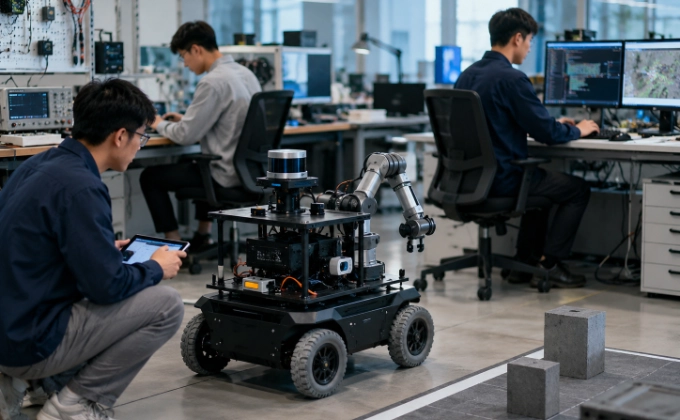
Robotics Teaching Labs: Specify the Student Exercises Before Choosing the Hardware
Oct 11, 2026

SCARA, Delta, or Six-Axis Robot: Choose by Motion, Orientation, and Work Envelope
Oct 11, 2026
The following scenario is illustrative and does not represent data from any specific deployment. A supplier demonstrates a bin picking system that finds a part in a bin of randomly placed components, picks it, and places it on a conveyor. The demonstration takes 8 seconds per pick. The buyer calculates that at 8 seconds per pick, the system will meet the required throughput. In production, the average cycle time is 14 seconds, and 5% of picks fail, requiring manual intervention. The throughput is 40% lower than projected. The problem is not that the demo was faked. The problem is that the demo used parts that were easy to separate, in a bin that was partially full, with a single part type. Production uses mixed parts, full bins, and parts that tangle. This article covers what to evaluate before assuming that a bin picking demo will translate to production performance.
Bin Picking Is More Than Object Detection
A successful bin picking cycle is a chain of events, each of which can be the bottleneck:
- Detect: The vision system identifies a part in the bin
- Pose estimation: The system determines the part's position and orientation
- Approach: The robot moves to a position from which it can grasp the part
- Grasp: The end-effector engages the part
- Extract: The robot lifts the part out of the bin without colliding with walls or other parts
- Verify: The system confirms that the part was successfully grasped (not dropped, not double-picked)
- Place: The robot moves the part to the destination
- Recover: If any step fails, the system must detect the failure and recover
A demo that shows steps 1-4 working smoothly does not prove that steps 5-8 will work in production. The extraction, verification, and recovery steps are where most production failures occur, and they are the steps most often omitted from demos.
Can the Parts Actually Be Separated?
Before evaluating vision systems and grippers, the team must answer a more fundamental question: can the parts be physically separated from each other? Some parts nest inside each other, hook onto each other, or tangle in ways that make them difficult to separate regardless of the robot's capabilities.
Part characteristics that affect separability:
- Nested parts: Parts with concave features that allow one part to sit inside another (e.g., cups, cones)
- Hooked parts: Parts with hooks, loops, or protrusions that catch on adjacent parts
- Flexible parts: Parts that bend or deform, making them difficult to grip and extract
- Slender parts: Long, thin parts that may lie across multiple other parts
- Tangled parts: Parts with wire, spring, or chain features that intertwine
Entangled and nested part families
If parts are entangled or nested, the vision system may correctly identify a part and the gripper may correctly grasp it, but the robot cannot extract it without also lifting adjacent parts. The system then needs to detect that multiple parts are grasped and decide whether to set them down and retry or to separate them in a secondary operation. This adds cycle time and may require a different gripper strategy (e.g., a scoop instead of a pinch, or a mechanical separator upstream of the bin).
The team should test part separability by physically attempting to separate parts from a representative bin. If a human cannot reliably separate a part from the bin in a few seconds, the robot is unlikely to do better.
Bin Geometry and Fill Level Effects
The bin's physical characteristics affect the robot's ability to reach parts:
- Depth: A deep bin may prevent the robot from reaching parts at the bottom without colliding with the walls
- Width and length: A large bin may require the robot to reach beyond its comfortable workspace to access corners
- Corner geometry: Sharp corners may trap parts or create collision risks for the gripper
- Fill level: A full bin means parts are on top, easy to see and grasp. A nearly empty bin means parts are at the bottom, partially occluded by the bin walls, and the robot must reach deeper into the bin.
When random bins feed a CNC operation, machine tending robot cell planning covers the downstream machine interfaces and work-cell sequence.
The fill level changes throughout the picking cycle. At the start, the bin is full and parts are easily accessible. As parts are removed, the remaining parts settle and may shift into positions that are harder to reach. The system must be tested at full, half, and low fill levels, not just at the optimal fill level.
Occlusion, Reflection, and Pose Ambiguity
Even with a 3D vision system, parts in a bin are partially occluded by adjacent parts. The visible portion may not be enough to determine the part's full pose (position and orientation). If the part has rotational symmetry or similar features on multiple faces, the vision system may not be able to determine which face is up.
Factors that affect pose estimation:
- Occlusion: Adjacent parts hide portions of the target part, reducing the visible features
- Reflection: Shiny parts reflect the light source, creating false edges or saturating the sensor
- Surface oil or residue: These change the reflectance and may create patterns that confuse the algorithm
- Dark parts: Absorb light, reducing the signal-to-noise ratio of the 3D sensor
- Multiple similar parts: If the bin contains multiple part types with similar geometry, the system may misidentify the part type
A 3D camera does not automatically solve these problems. The 3D point cloud may be incomplete or noisy due to reflection and occlusion. The algorithm must be robust to these conditions, or the system will produce false positives (attempting to grasp where there is no part) and false negatives (failing to detect a graspable part).
The earlier decision between 2D vs 3D robot vision is only one part of determining whether a random-bin pick will succeed.
Grasp and End-Effector Feasibility
The vision system may correctly identify a part and its pose, but the gripper may not be able to grasp it in the available space. The grasp plan must consider:
- Contact surface: Does the gripper have a surface that can contact the part in the identified pose?
- Grasp direction: Can the robot approach the part from the required direction without colliding with the bin walls or adjacent parts?
- Vacuum seal: If using a vacuum gripper, is there a flat or smooth enough surface on the part to create a seal?
- Finger clearance: If using a mechanical gripper, is there space between the target part and adjacent parts for the fingers to open and close?
- Double pick risk: Will the gripper grasp two parts instead of one? If the parts are close together or nested, the gripper may close on two parts simultaneously.
The gripper design is part of the bin picking system, not a separate component. A gripper that works for isolated parts on a flat surface may fail in a bin where parts are close together and partially occluded.
The robot gripper selection guide compares gripping architectures, while the bin trial must test extraction from neighboring parts and bin walls.
Collision-Free Extraction From the Bin
Grasping the part is only half the task. The robot must extract it from the bin without colliding with the bin walls, adjacent parts, or its own wrist. The extraction path must be planned considering:
- Wrist and gripper size: The wrist and gripper occupy space that may collide with bin walls or adjacent parts during extraction
- Part orientation after grasp: The part may shift during lifting, changing the collision envelope
- Bin wall proximity: Parts near the bin wall may require a specific extraction direction to avoid collision
- Singularity positions: Certain robot configurations near the bin walls may cause singularity issues that limit the available extraction paths
Wrist and gripper clearance
The collision check must include the full wrist and gripper assembly, not just the gripper fingers. A common failure is to plan an extraction path that works for the gripper but collides with the wrist or a cable bracket. The full assembly's collision envelope must be verified at every position in the extraction path.
Cycle-Time Distribution and Slow-Tail Failures
Bin picking cycle time is not a single number. It is a distribution. Some picks are fast (the part is on top, well-separated, and easily grasped). Some picks are slow (the part is at the bottom, partially occluded, requiring a re-grasp or a different approach angle). The distribution has a long tail of slow picks and failures that significantly affects throughput.
The relevant metrics are:
- Median cycle time: The time for a typical pick
- 90th percentile (or higher) cycle time: The time for a slow pick
- Retry rate: How often the system must re-attempt a grasp
- Re-grasp rate: How often the first grasp fails and the robot must set the part down and try again
- Manual reset rate: How often a human must intervene to clear a jam, reorient parts, or restart the system
Retries and manual resets
Reporting only the median cycle time or the fastest pick creates an unrealistic throughput projection. The slow tail and the failure rate dominate the average cycle time in production. A system with a 6-second median and a 15% retry rate has an effective average cycle time closer to 8 seconds, plus the downtime for manual resets.
The buyer should require the supplier to report cycle time as a distribution over a representative number of picks (at least 100, preferably 500+), including retries, re-grasps, and manual interventions. The test should use the actual production parts, bin geometry, and fill levels, not demo parts in a demo bin.
Exception Handling and Human Escalation
The system must have defined responses for exception conditions:
- Double pick: The gripper picks up two parts. The system must detect this (e.g., via a weight check or vision verification) and set both parts back, then retry.
- Entangled cluster: The gripper picks up a cluster of tangled parts. The system must detect the excess weight or size and set the cluster back.
- Dropped part: The part slips during lifting. The system must detect the drop and retry or flag for manual intervention.
- Empty scene: The vision system cannot find any graspable parts. The system must signal that the bin is empty or that remaining parts require manual handling.
- Continuous failure: If the system fails multiple consecutive picks, it should stop and request human intervention rather than continuing to fail.
The exception handling logic should be documented and tested. A system that silently retries indefinitely or that continues production after a double pick is not production-ready.
Representative Pilot Matrix
Before approving a bin picking system, the buyer should define a pilot test matrix that covers the full range of production conditions:
- Part variants: Each part type that will be picked, including the most difficult
- Fill levels: Full, half, and low
- Surface conditions: Clean, oily, scratched, wet
- Bin locations: Center, corners, near walls
- Shift conditions: Lighting, ambient temperature, operator availability
The matrix should define, for each combination, the required success rate, maximum cycle time, and maximum manual intervention rate. The test results are recorded as the baseline for production acceptance.
A robot pilot acceptance criteria framework helps establish project-specific pass/modify/stop decisions after representative bin picking tests.
NIST's Robotic Grasping and Manipulation Assembly project maintains grasping performance metrics and Assembly Task Boards (ATB) for benchmarking robotic manipulation. These are research tools designed to provide standardized measurement methods for comparing robotic systems. They can be used to design a measurement framework for a bin picking evaluation, ensuring that the test measures the right things. They are not, however, a guarantee that a system that performs well on the benchmark will perform well in a specific commercial application. The benchmark provides methodology; the application provides the pass/fail criteria.
Considering robotic bin picking for loose or mixed parts? Send representative part photos or drawings, bin dimensions, fill-level range, pickup and placement requirements, and the production cycle target. AIsirRobot can organize these inputs for a preliminary application assessment and flag sample trials that a manufacturer or integrator must complete.
Share on Social:


Contact Us
In This Article
Central Vacuum Pump vs On-Tool Ejector: Choosing the Vacuum Source for Robotic Picking
Oct 11, 2026
AMR Tugger Tow Capacity: Drawbar Pull, Cart Resistance, and Starting Loads
Oct 11, 2026
Robotics Teaching Labs: Specify the Student Exercises Before Choosing the Hardware
Oct 11, 2026
SCARA, Delta, or Six-Axis Robot: Choose by Motion, Orientation, and Work Envelope
Oct 11, 2026