Contact Us



Restaurant Marketing & Food Delivery Robot: Dual-Function Automation for Food Service
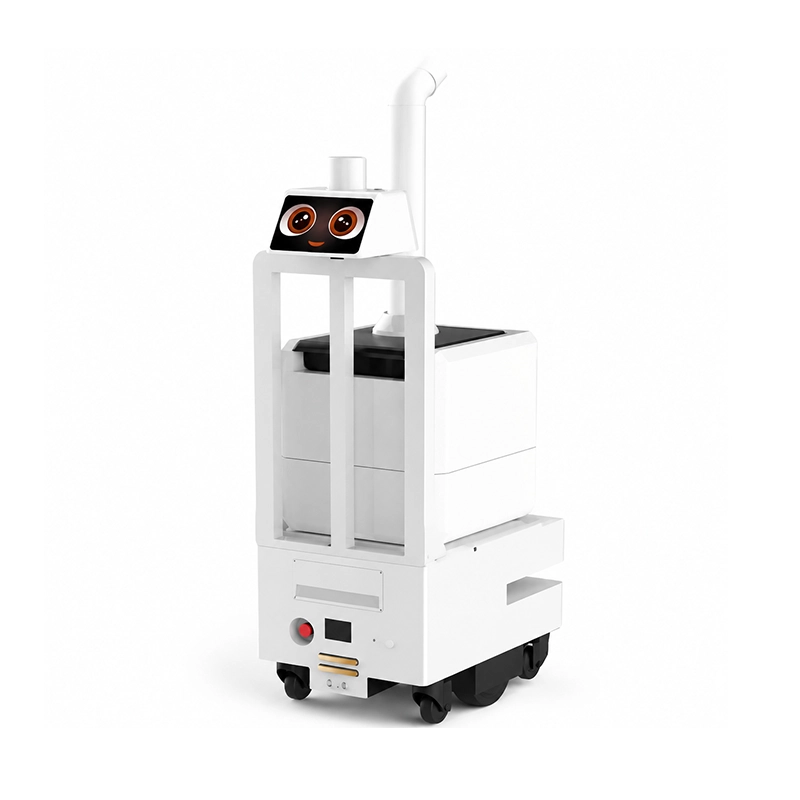
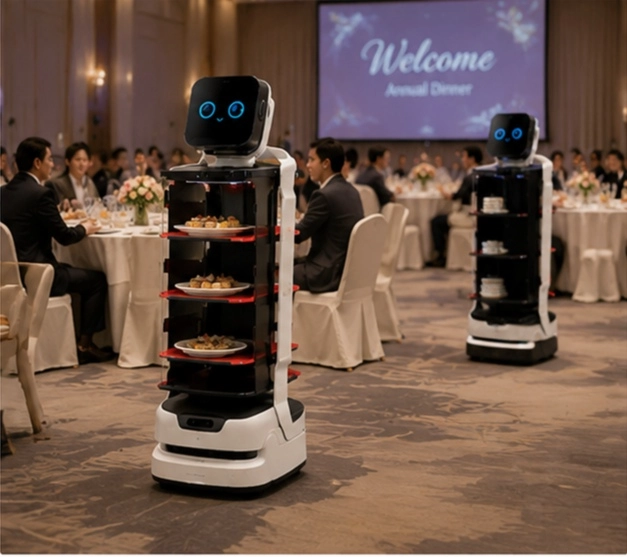
The Restaurant Marketing & Food Delivery Robot is an autonomous service robot designed to perform two roles in a single deployment: transport food from kitchen to table during peak service hours, and actively attract, greet, and engage customers during off-peak periods. With a three-layer open-tray system, 10 hours of battery life under the stated cruise scenario, and LiDAR-based navigation, this robot fits into restaurant operations where both labor efficiency and customer engagement matter. AIsirRobot provides model selection, system integration, deployment, and after-sales coordination as a single point of contact for your restaurant automation project.



Quick Fit Summary
|
Item |
Details |
|
Best-fit environments |
Restaurants, food courts, banquet venues, hotel dining areas |
|
Core differentiator |
Four operating modes: delivery, customer attraction, table guidance, cruise |
|
Key limitations |
Cannot navigate stairs; requires stable Wi-Fi or 4G; open-tray design not suitable for temperature-controlled transport |
|
Site requirements |
Flat floors, ≤ 5° slope, passable aisles (minimum width to be confirmed by site assessment), mapping area ≤ 5,000 m² |
|
Requires confirmation |
Rated payload capacity, minimum aisle width, IP rating, operating temperature, certifications |
 Photo
Photo
Core Features

LiDAR Navigation with Multi-Sensor Positioning

AI Tag Recognition for Low-Light Conditions

Multi-Robot Scheduling

Six-Microphone Array with 360-Degree Sound Source Positioning

Five Switchable Voice Profiles

Four Operating Modes

Color-Changing Status Indicator Light Strip

Food Safety Cover

10.1-Inch Touchscreen with 13-Megapixel Camera

Multi-Language Support

Cloud Service Platform

Body Material
Application Scenarios
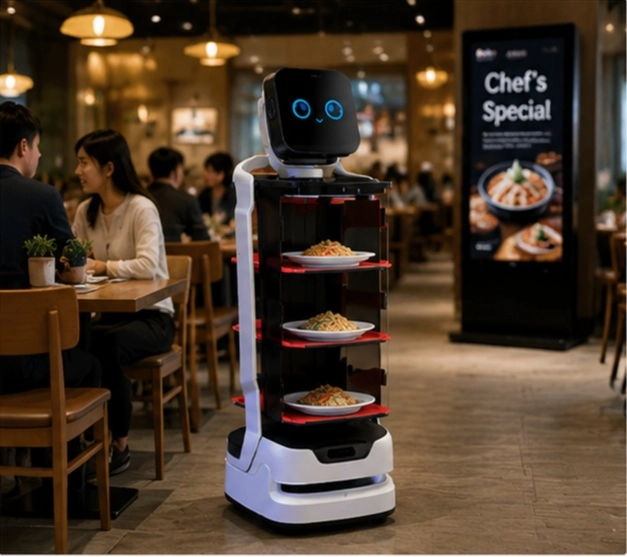
Restaurants and Restaurant Chains
Food delivery, customer guidance, and promotional interaction during peak and off-peak hours. One robot supports both service delivery and customer engagement.
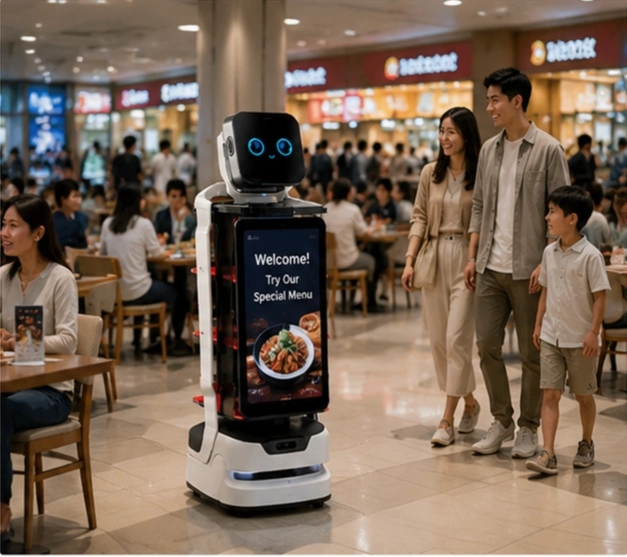
Food Courts and Shopping Mall Dining Areas
Table guidance, sample distribution, and promotional activities in high-traffic dining areas. Multi-mode operation improves customer flow and seating efficiency.
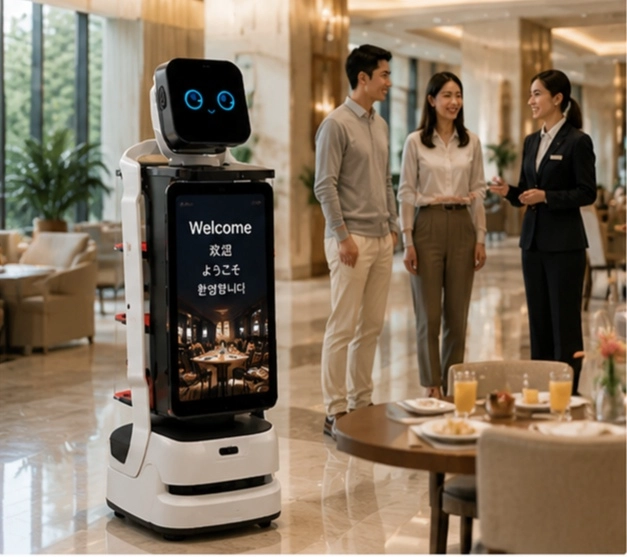
Hotels with Restaurant Operations
Breakfast delivery and guest interaction support in hotel dining areas. Multi-language features help serve international guests.
Banquet and Event Venues
Preset-route food delivery and tray collection for large events. Multi-robot coordination supports efficient service across multiple tables.
This Robot Compares to Other Service Robot Types
The following comparison describes typical configurations. Actual specifications vary by manufacturer and model.
| Feature | AGV (Typical) | Standard Delivery Robot (Typical) | Marketing & Delivery Robot |
| Primary function | Warehouse and factory logistics | Item transport only | Item transport + customer engagement |
| Navigation (typical) | Fixed paths (magnetic strips, wires) | Dynamic mapping (varies by model) | LiDAR + IMU + depth vision + infrared |
| Customer interaction | None | Screen display, basic voice prompts (varies by model) | Multi-voice interaction, greeting, marketing, table guidance, ad playback |
| Operating modes | Single mode (fixed route) | Single mode (delivery) | Four modes: delivery, customer attraction, table guidance, cruise |
| Typical payload | 100–2,000 kg | 10–40 kg (varies by model) | 10 kg per tray; total rated payload available upon confirmation |
| Best fit | Controlled industrial environments | Hotels, hospitals, offices | Restaurants, food courts, banquet venues |
Robot vs. Human Staff Service
| Factor | Human Staff Service | Marketing & Delivery Robot |
| Delivery availability | Limited by shift schedules, breaks, and staff turnover | Up to 10 hours per charge under stated cruise scenario |
| Off-peak utilization | Delivery staff idle during off-peak hours | Robot switches to customer attraction mode |
| Customer engagement | Depends on individual staff personality and mood | Standardized voice interaction with 5 selectable profiles |
| Peak-hour capacity | Limited by available servers | Multiple robots can deploy with autonomous intersection avoidance |
| Labor cost | Ongoing: wages, benefits, training, turnover | One-time hardware + integration; ongoing: electricity, maintenance, cloud services |
| Limitations | Cannot work extended hours without fatigue | Cannot handle stairs; requires network coverage; battery requires 4.5-hour charging cycle |
The robot’s dual-function design means one unit can handle tasks that might otherwise require both a delivery robot and a dedicated greeter or promotional display. This is the key differentiator for restaurant operators evaluating robot deployment.
Technology and Specification Guide
FAQS
Q: How is this robot different from a standard delivery robot?
This robot is a dual-function unit that combines food delivery with customer engagement. In addition to transporting food, it can greet customers, recommend menu items, play promotional content, guide customers to their tables, and cruise along preset routes. A standard delivery robot only transports items. The four operating modes allow the robot to remain productive during off-peak hours when a delivery-only robot would be idle.
Q: How many robots do I need for my restaurant?
This depends on your daily delivery volume, the average time per delivery, and the robot’s 10-hour operating window. Use the delivery frequency framework in the ROI section above with your own data to calculate the number of robots needed. Multiple units can operate simultaneously with autonomous intersection avoidance. Contact AIsirRobot with your delivery volume data for a fleet sizing recommendation.
Q: How long before I see ROI?
Payback period depends on your current labor costs, daily delivery volume, and the robot’s hardware and integration cost. The dual-function design means the robot can offset labor in two areas simultaneously. Use the ROI framework in this page with your own verified data, or contact AIsirRobot for a tailored estimate.
Q: Can the robot replace waiters?
The robot is designed to handle repetitive delivery and customer engagement tasks, not to replace all staff functions. Servers still take orders, handle special requests, and provide personalized service. The robot takes over the delivery and basic greeting/promotional portion — freeing staff for higher-value interactions. In many deployments, the robot augments rather than replaces human staff.
Q: Can the robot work during a power outage?
The robot operates on battery power. Whether it can continue functioning during a power outage depends on whether dependent systems (POS, network infrastructure, automatic doors) have backup power. Charging cannot occur during a power outage. Specific behavior during power interruptions should be confirmed during deployment planning.
Q: How does the multi-robot scheduling work?
When multiple units are deployed in the same venue, they avoid each other at intersections based on pre-set priority numbers. Each robot is assigned a priority number during configuration, and the scheduling system manages right-of-way at crossing points. Maximum fleet size is available upon request.
Q: Can I switch the robot’s voice personality?
Yes. The robot supports five switchable voice profiles: sweet female, cute child, friendly female, humorous uncle, and little girl. Voice profiles can be switched through the cloud service platform. Commercial terms for voice package management are available upon request.
Q: What languages does the robot support?
The robot supports multi-language interaction including English, Japanese, and Korean. Additional language packs are available as a paid cloud service upgrade. Contact AIsirRobot to discuss language requirements during the requirements assessment phase.
Q: Can the robot integrate with our POS and building systems?
The robot is designed for integration with POS systems, elevators, automatic doors, and mini-program platforms. Integration capabilities depend on your building infrastructure and system compatibility. AIsirRobot evaluates your systems during the deployment planning phase. See the System Integration section for the status of each integration type.
Q: What warranty and after-sales support is included?
The robot comes with a 12-month warranty. Warranty coverage, support response times, spare parts availability, and software update terms are defined in the final quotation and service agreement. AIsirRobot provides ongoing technical assistance; extended support terms are quoted according to the agreed service scope.
Q: What is the minimum order quantity and lead time?
The minimum order quantity is 1 unit. Lead time is 35 days from order confirmation to shipment. Shipping time depends on your destination country and logistics arrangements.
Request a Quote or Technical Evaluation
Tell us what you need the robot to do. Even if some technical details are not yet confirmed, our team can help evaluate suitable options.
- Application: Briefly describe the task, workflow, or problem you want the robot to handle.
- Key requirements: Share any known payload, reach, capacity, runtime, accuracy, speed, or other performance needs.
- Site & integration: Tell us about the operating environment, layout, existing equipment, or software interfaces if relevant.
- Quantity & timeline: Let us know the expected quantity, destination country, and target delivery or deployment time.