Contact Us



Autonomous Disinfection Robot Solutions for Hospitals, Offices and Commercial Facilities
Autonomous disinfection robots are self-driving machines designed to perform surface and air disinfection in indoor environments without manual operation. Equipped with spray fogging systems or UV-C technology, these robots navigate autonomously through facilities, deliver consistent disinfection coverage, and help reduce human exposure to hazardous chemicals and pathogens. For facility managers handling large areas with limited staff, these robots offer a way to reduce manual disinfection workload, improve hygiene consistency, create traceable disinfection records, and support large-area facilities, helping limit the need for additional labor. As a disinfection robot supplier, AIsirRobot provides turnkey solutions that include technology selection, deployment, integration, and ongoing technical support for healthcare, commercial, industrial, and public facilities.
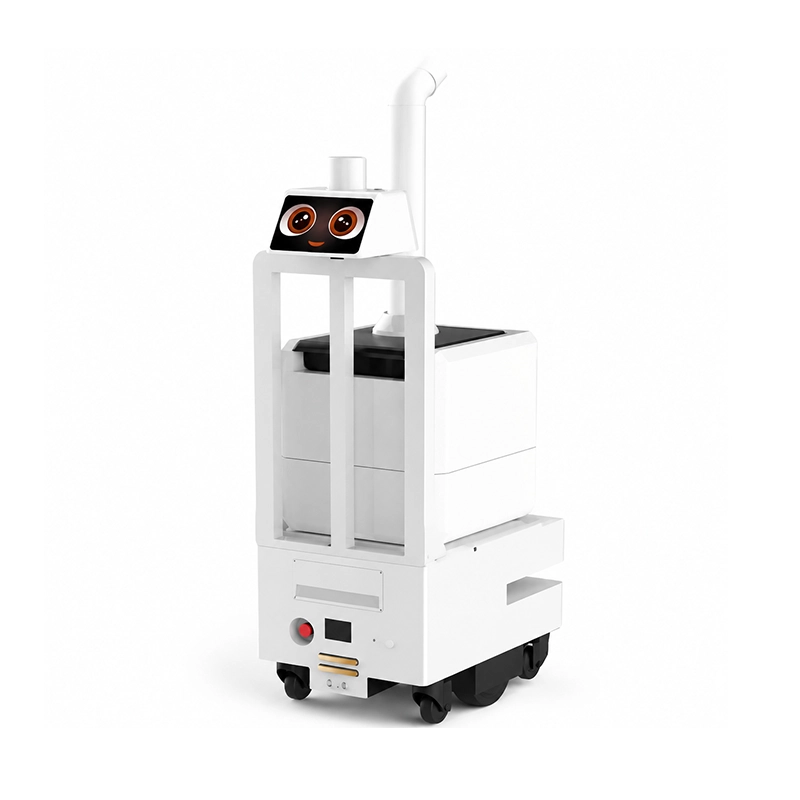



What Is an Autonomous Disinfection Robot?
An autonomous disinfection robot is a mobile platform that navigates indoor environments independently to perform disinfection tasks without human supervision. Unlike stationary UV-C lamps or manual spray equipment, these robots combine autonomous navigation with active disinfection delivery, allowing them to move through target areas, stop at designated points, and apply disinfectant automatically.
The core capabilities of an autonomous sanitizing robot include:
- Self-guided navigationusing LiDAR and V-SLAM fusion mapping with real-time obstacle detection
- Automated disinfection deliverythrough spray fogging, UV-C irradiation, or hybrid systems
- Scheduled task executionwith pre-set times and multi-point targeting
- Digital reportingthrough cloud-based platforms for compliance and audit purposes
- Elevator integrationfor cross-floor operation in multi-story facilities
The model featured on this page utilizes spray fogging technology. A commercial disinfection robot is designed to operate in environments where consistent, repeatable disinfection matters, including hospitals, office buildings, cleanrooms, schools, and transportation hubs.
 Photo
Photo
Why Facilities Need Automated Disinfection
Traditional disinfection methods depend heavily on manual labor. Staff repeat the same process daily, often with inconsistent coverage, limited documentation, and potential chemical exposure risks. For facilities managing large areas or meeting high hygiene standards, these limitations create measurable operational gaps.
The autonomous disinfection robot solution addresses these challenges through:
- Consistent Coverage: Pre-programmed routes ensure every target area receives uniform disinfection, eliminating the variability of manual spraying.
- Reduced Labor Dependency: Once deployed, the robot executes disinfection tasks independently, freeing staff for higher-value responsibilities.
- Digital Disinfection Records: Task logs and scheduling data can be accessed through the cloud-based platform, supporting compliance and audit requirements.
- Flexible Disinfection Media: Compatible with hypochlorous acid, sodium hypochlorite, hydrogen peroxide, and peracetic acid, allowing facilities to select the most appropriate agent for their environment.
- Remote Deployment Capability: Navigation maps can be built and configured remotely across regions, reducing on-site setup time.
- Adjustable Spray Output: An integrated fogging adjustment knob allows operators to control spray volume based on room size and disinfection requirements, while a visible water level indicator provides real-time tank status.
Why Choose Spray Fogging Technology
Spray fogging disinfection uses ultra-fine droplets (2~5 μm) that remain suspended in air before settling on surfaces. This delivery method offers specific advantages for facilities with complex layouts or areas where direct line-of-sight disinfection may be insufficient.
✅ Suitable for Complex Spaces
Fogging droplets can potentially reach surfaces that direct light may not cover, including areas behind equipment, under furniture, and around structural obstacles. The actual coverage depends on room configuration, airflow patterns, and the specific disinfection media used.
✅ Large-Area Coverage
With a spray efficiency of up to 3,000 mL/h and a disinfection rate of 1,000 m³ per 15 minutes, a spray fogging robot can process significant spatial volume per deployment cycle. A 16 L water tank supports extended operation between refills, reducing the need for frequent intervention during scheduled disinfection rounds.
✅ Compatible with Multiple Disinfection Media
The robot supports hypochlorous acid, sodium hypochlorite, hydrogen peroxide, and peracetic acid. This allows facility managers to select the disinfectant that aligns with their hygiene protocols, regulatory requirements, and surface material compatibility.
✅ Adjustable for Different Environments
An integrated fogging adjustment knob enables operators to fine-tune spray output based on room size, ceiling height, and target disinfection level. A visible water level indicator with status lights (green for normal operation, red for low water) provides immediate tank status, helping operators plan refill schedules without interrupting active disinfection cycles.
How to Choose the Right Disinfection Robot
Selecting the appropriate autonomous disinfection robot depends on facility-specific requirements. The following factors help guide the selection process:
1. Facility Size and Layout
The size and complexity of the target environment determine the mapping range, runtime, and navigation capabilities required. Facilities with large floor areas or complex layouts benefit from robots with extended mapping capability and multi-sensor fusion navigation for reliable positioning.
2. Required Disinfection Level
Different environments have different hygiene standards. Healthcare facilities and cleanrooms typically require higher disinfection assurance than general commercial spaces. The choice of disinfection method, spray particle size, and compatible media should align with the facility’s hygiene protocols.
3. Operation Environment
Consider whether the robot will operate in occupied or unoccupied spaces, during business hours or after hours. Obstacle detection capability, safety features, and noise levels may influence suitability for different operational windows.
4. Chemical Compatibility
Verify that the robot supports the disinfectants required by your facility’s protocols. Some environments require specific agents such as hydrogen peroxide for cleanroom applications or hypochlorous acid for general surface disinfection.
5. Integration Requirements
For multi-floor facilities, elevator integration may be essential. For multi-building campuses, fleet management capability becomes a priority. Assess whether the robot can integrate with existing building systems and management platforms.
Key Technologies
- Intelligent Disinfection Mode: Pre-set disinfection times for automatic task execution, reducing manual intervention.
- Large-Scale LiDAR Mapping: Build navigation maps covering up to 40,000 ㎡ with optimized software algorithms and enhanced mapping engine.
- Remote Navigation Deployment: Support for cross-region remote map construction and deployment, minimizing on-site setup time.
- Broad Application Range: Suitable for hospitals, offices, cleanrooms, schools, transportation hubs, and other public facilities.
- Intelligent Control: Cloud-based platform for task scheduling, monitoring, and configuration management.
- Auto-Return Charging: Automatic return to charging station when battery falls below a user-defined threshold.
- Multi-Point Disinfection: Customizable target point positioning allows sequential disinfection across multiple designated locations.
- Autonomous Obstacle Avoidance: LiDAR SLAM + V-SLAM fusion enables indoor autonomous navigation with rapid obstacle detection and bypass.
Deployment & Integration Process
Step 1: Requirement Assessment
We evaluate your facility’s area, industry regulations, hygiene standards, and operational constraints to determine the appropriate disinfection approach. This includes square footage measurement, traffic pattern analysis, and identification of high-priority disinfection zones.
Step 2: Solution Selection
Based on the assessment, we recommend the most suitable configuration as a customized disinfection solution, including disinfection media compatibility, coverage requirements, and optional features such as elevator integration.
Step 3: Deployment & Integration
Our team handles LiDAR-based mapping, route optimization, obstacle calibration, and optional elevator system integration specific to your facility layout. For multi-unit deployments, fleet management coordination can be provided as part of the integration service for facilities operating multiple robots across large or multi-building sites.
Step 4: Training & Support
We provide operational training, maintenance guidance, and remote technical support as part of our robotics integration service, ensuring long-term performance and reliability.
Industry Applications
Healthcare Facilities
Hospitals, clinics, and laboratories face strict requirements for consistent, traceable disinfection protocols. Manual spraying introduces variability in coverage, limited documentation, and repeated chemical exposure for staff.
The autonomous disinfection robot delivers multi-point spraying with scheduled execution across nurse stations, patient rooms, and corridor junctions. Task execution records can be accessed through the cloud-based platform, supporting compliance documentation for internal audits and regulatory inspections. By automating the disinfection process, healthcare staff reduce direct contact with disinfectants while maintaining documented hygiene standards.
Commercial Spaces
Hotels, shopping malls, office buildings, and airports need efficient large-area coverage with minimal operational disruption. Manual disinfection of expansive commercial environments requires significant labor hours and often produces inconsistent results across shifts.
The robot can be scheduled to operate during low-traffic periods, covering lobby areas, escalator zones, and restroom entrances without additional labor costs. With a 16 L water tank and a 3~4 hour runtime, the robot is well-suited for single-shift disinfection cycles in medium to large commercial spaces, while the mapping capability of up to 40,000 ㎡ supports extensive facility coverage.
Cleanrooms & Industrial Facilities
Manufacturing facilities, pharmaceutical plants, and controlled environments require stable, repeatable sanitization processes. Variability in manual application can compromise contamination control protocols.
The robot’s consistent path planning and ultra-low volume fogging (2~5 μm particle size) support controlled environment hygiene management. Compatible disinfection media include hydrogen peroxide and peracetic acid, which are commonly used in cleanroom and pharmaceutical applications where material compatibility and residue standards permit.
Public Facilities
Schools, government buildings, and transportation hubs need efficient large-area coverage with minimal operational disruption. Limited custodial staff and high-traffic schedules make consistent manual disinfection difficult to sustain.
The autonomous navigation and multi-point disinfection capabilities allow these facilities to maintain hygiene standards without dedicating additional personnel to manual spraying. Weekly recurring schedules can be configured to align with facility operating cycles.
Technical Specifications
FAQS
Q1: How to choose between UV-C and fogging disinfection robots?
UV-C robots use ultraviolet light to inactivate microorganisms on surfaces, which is effective for direct line-of-sight areas but may have reduced effectiveness in shadowed or obstructed zones. Fogging robots disperse ultra-fine droplets (2~5 μm) that can potentially reach surfaces that direct light may not cover, depending on room configuration and airflow. Each technology has its strengths, and the optimal choice depends on facility layout, disinfection requirements, and operational priorities. We help clients evaluate their specific needs to recommend the most appropriate technology.
Q2: Can autonomous disinfection robots operate across multiple floors?
Yes. With the optional elevator integration feature, the robot can automatically call elevators, switch to floor-specific navigation maps, and continue disinfection tasks on different floors without manual intervention.
Q3: Are disinfection robots safe around people?
The robot is equipped with LiDAR-based obstacle detection and ultrasonic sensors for navigation safety. It automatically bypasses obstacles to maintain stable and safe operation. An emergency stop button is also included for immediate intervention. However, for optimal chemical safety, we recommend operating the robot during low-traffic periods or in unoccupied areas.
Q4: What customization and deployment services are available?
We provide a full deployment service including facility assessment, navigation mapping, route configuration, optional elevator integration, operational training, and remote technical support. Disinfection target points, schedules, and minimum battery thresholds can be customized through the cloud-based control platform, including weekly recurring schedules for automated recurring disinfection cycles. The fogging adjustment knob allows operators to manually fine-tune spray output for different room sizes and disinfection requirements.
Q5: How do I calculate ROI for a disinfection robot?
Key factors include reduced repetitive labor costs, improved disinfection consistency, traceable compliance records, and reduced staff exposure to chemicals. For a detailed breakdown of ROI calculation factors, see the ROI Considerations section above. We also provide customized ROI assessments based on your facility size, labor costs, and hygiene requirements.
Request a Quote or Technical Evaluation
Tell us what you need the robot to do. Even if some technical details are not yet confirmed, our team can help evaluate suitable options.
- Application: Briefly describe the task, workflow, or problem you want the robot to handle.
- Key requirements: Share any known payload, reach, capacity, runtime, accuracy, speed, or other performance needs.
- Site & integration: Tell us about the operating environment, layout, existing equipment, or software interfaces if relevant.
- Quantity & timeline: Let us know the expected quantity, destination country, and target delivery or deployment time.