Contact Us



Commercial Delivery Robot: Autonomous Indoor Delivery for Hotels, Restaurants, and Healthcare
The Commercial Delivery Robot is an autonomous indoor delivery robot with a 23.8-inch interactive screen, open-tray design with AI detection, and 360-degree navigation. It is designed for guest-facing delivery in hotels, restaurants, hospitals, and office buildings where the robot interacts with people during item handoff.



Product Overview
The commercial delivery robot is designed to transport food, medication, and supplies autonomously across indoor environments. With a 40 kg total payload capacity, up to 12.5 hours of battery life, and a 59 cm minimum aisle width, the Commercial Delivery Robot fits into the operational layouts that most hotels, restaurants, and healthcare facilities already have. AIsirRobot provides model selection, system integration, deployment, and after-sales coordination as a single point of contact for your delivery automation project.
Whether you are evaluating your first service robot or scaling a multi-unit fleet, the Commercial Delivery Robot offers a configuration-ready platform that adapts to your floor plan, workflow, and customer interaction style. This page covers everything you need to evaluate the Commercial Delivery Robot for your facility: product specifications, ROI framework, comparison with traditional methods, deployment process, and a buyer’s checklist.
 Photo
Photo
Core Features
Adaptive Human-Robot Interaction
Interactive head movement, large screen display and guided controls create a user-friendly handover experience for guests, patients and staff.
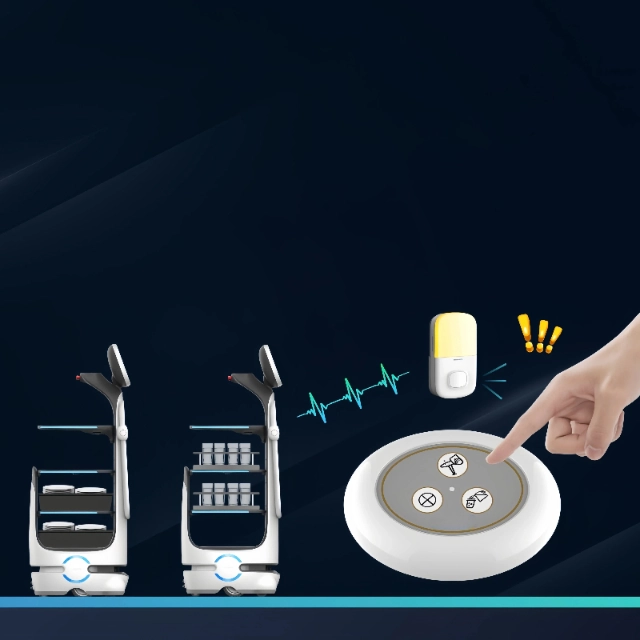
AI Tray Detection & Self-Collection
AI detection, illuminated trays, screen instructions and voice prompts guide users through accurate and efficient item collection.
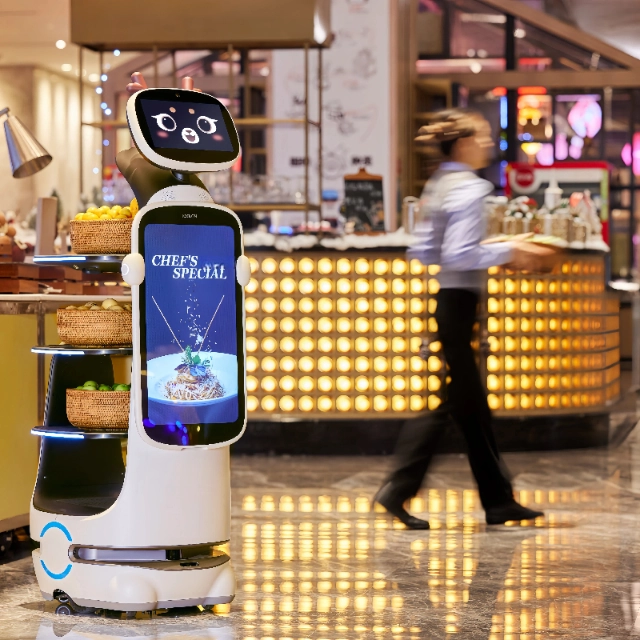
360° Navigation & Obstacle Recognition
Four stereo vision sensors, VSLAM and RGB camera enable real-time mapping, positioning and obstacle detection in dynamic environments.
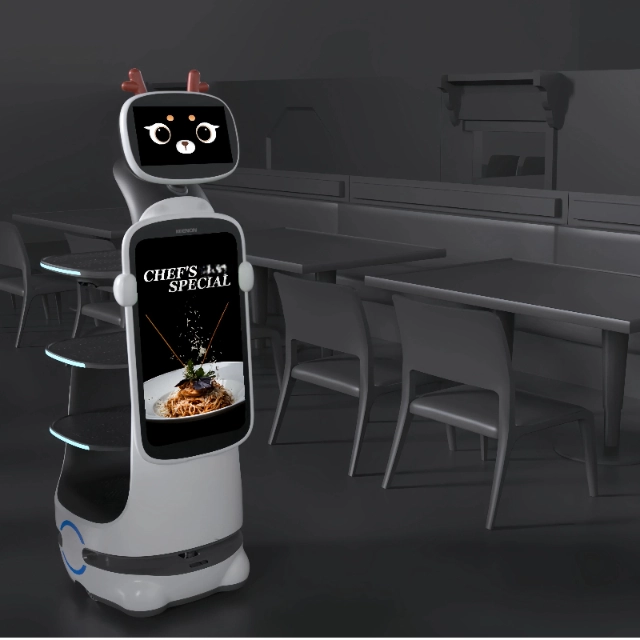
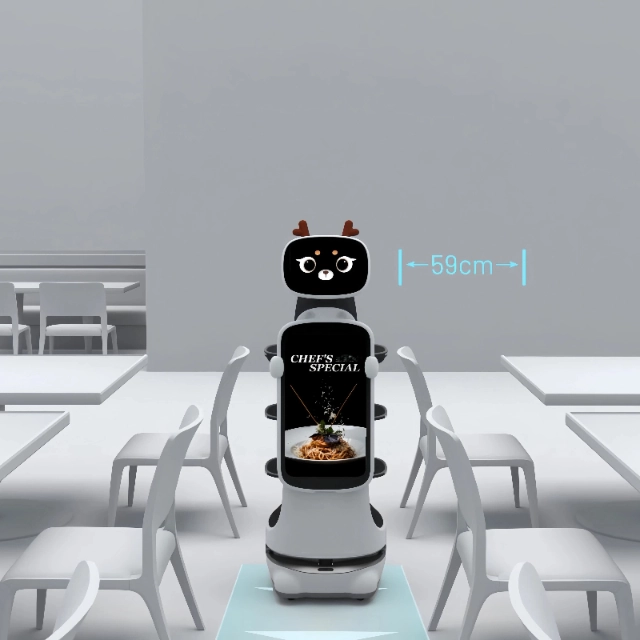
Narrow-Aisle Operation
The 59 cm compact body design allows operation in tight spaces such as restaurants, hotels and healthcare corridors.
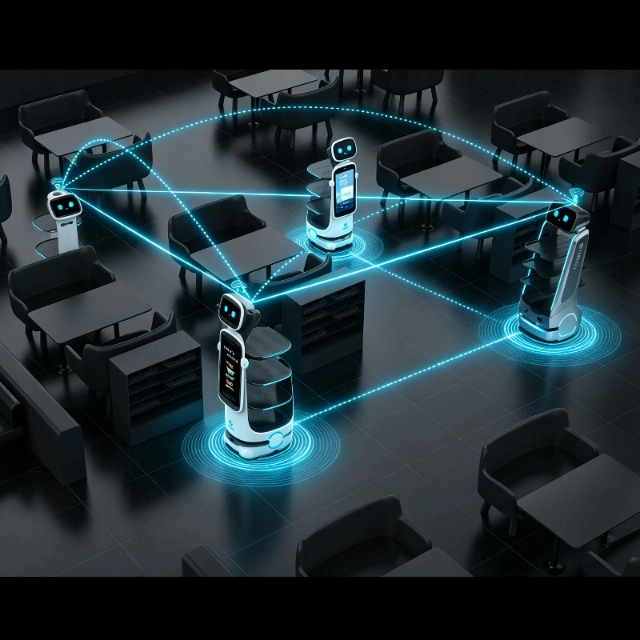
Mixed-Fleet Collaboration
Supports multiple robot models working together to meet different delivery tasks and operational requirements.
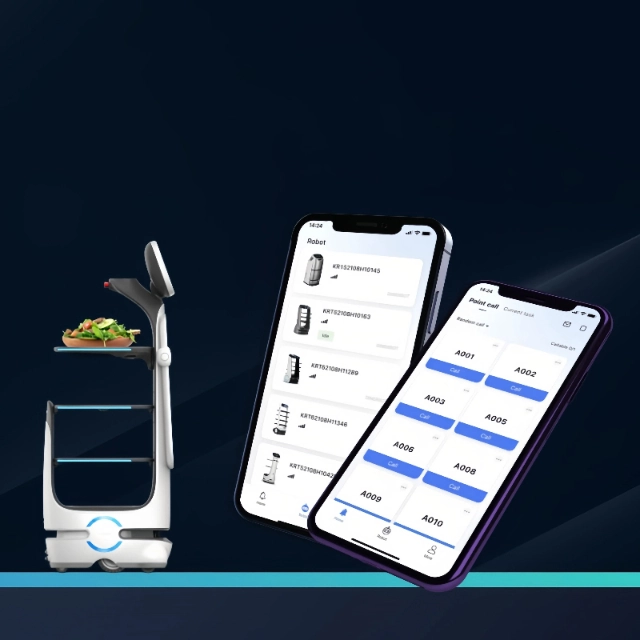
Multi-Language Support
Provides multilingual interaction including English, Japanese and Korean, with customizable language options for global applications.
Application Scenarios

Hotels
Room service and guest delivery automation

Restaurants
Food delivery and self-collection support

Healthcare
Medical supplies and document transport

Offices
Internal logistics and smart delivery
Commercial Delivery Robot vs. Traditional Delivery Methods
Commercial Delivery Robot vs. Human Staff Delivery
| Factor | Human Staff Delivery | Commercial Delivery Robot Robot Delivery |
| Availability | Limited by shift schedules, breaks, sick leave, and turnover | Up to 12.5 hours continuous operation per charge; no breaks or turnover |
| Consistency | Variable—speed, accuracy, and attitude fluctuate by person and shift | Consistent—same route, same speed, same interaction every time |
| Peak-hour capacity | Limited by available staff; hiring surge staff is costly and slow | Additional robots can be deployed during peak hours; fleet scales with demand |
| Labor cost | Ongoing: wages, benefits, training, management overhead, turnover costs | One-time hardware + integration; ongoing: electricity, maintenance, software updates |
| Guest experience | Depends on staff mood, training, and workload | Standardized screen interaction, multi-language support, branded customization |
| Limitations | Cannot work 24/7 without significant staffing costs | Cannot handle stairs without elevator integration; requires 59 cm minimum aisle width; battery requires charging cycles |
Commercial Delivery Robot vs. Other Payload-Class Robots
The Commercial Delivery Robot’s 40 kg payload capacity places it in the mid-to-heavy range for commercial delivery robots. Lighter robots (10–20 kg) are suited for smaller items such as documents and small parcels. Heavier robots (50+ kg) are typically designed for industrial or warehouse logistics rather than guest-facing environments.
| Factor | Lighter Robots (10–20 kg) | Commercial Delivery Robot (40 kg) | Heavier Robots (50+ kg) |
| Typical items | Documents, small parcels, mail | Food trays, room service items, supplies, pharmacy goods | Industrial materials, large pallets |
| Best fit | Office document delivery, small-item logistics | Hotels, restaurants, hospitals, mixed-use facilities | Warehouses, factories, logistics hubs |
| Aisle width requirement | Often narrower (45–55 cm) | 59 cm | Often wider (65+ cm) |
| Guest interaction | Limited (smaller screens, basic prompts) | High (23.8-inch screen, voice, tray lighting, adaptive head) | Minimal (designed for controlled environments) |
| Battery life | Varies by model | 9–12.5 hours | Varies by model |
The Commercial Delivery Robot’s combination of 40 kg payload, 59 cm aisle width, 23.8-inch screen, and guest-facing interaction design makes it suitable for environments where the robot must carry substantial items while maintaining a presentable, interactive presence.
Aisle width ranges for lighter and heavier robots are typical industry ranges and vary by specific model.
Knowing how the Commercial Delivery Robot compares to alternatives is one thing. Knowing what it costs—and what it saves—is what drives the purchasing decision.
Technology and Specification Guide
FAQS
Q: How many delivery robots do I need?
This depends on your daily delivery volume, the average time per delivery (travel + handoff + return), and the robot’s operating hours. As a framework: if your robot completes Q deliveries per hour and operates Q hours per day, one robot can handle approximately Q deliveries per day. For higher volumes or multiple service zones, a multi-robot fleet may be required. Contact AIsirRobot with your delivery volume data for a fleet sizing recommendation.
Q: How long before I see ROI on a delivery robot?
Payback period depends on your current labor costs, daily delivery volume, and the robot’s hardware and integration cost. In markets with high labor costs and high delivery volumes, payback can be achieved in Q, not Q. Use the ROI framework in this page with your own data, or contact AIsirRobot for a tailored estimate.
Q: Can the Commercial Delivery Robot replace waiters or front desk staff?
The Commercial Delivery Robot is designed to handle repetitive delivery tasks, not to replace all staff functions. Servers still take orders, interact with guests, and handle tasks requiring human judgment. Front desk staff still manage check-in, guest inquiries, and issue resolution. The robot takes over the delivery portion—freeing staff for higher-value interactions. In most deployments, the Commercial Delivery Robot augments rather than replaces human staff.
Q: How many deliveries can the Commercial Delivery Robot make per hour?
Delivery rate depends on route distance, elevator wait times (if multi-floor), handoff time, and traffic conditions. A typical single-floor delivery (travel + handoff + return) of Q–Q minutes yields approximately Q–Q deliveries per hour. Multi-floor deliveries with elevator integration may take longer per trip. Actual delivery rates vary based on your facility layout, route distance, and traffic conditions.
Q: Can the Commercial Delivery Robot work during a power outage?
The Commercial Delivery Robot runs on battery power and can continue operating during a short power outage. However, elevator integration, automatic doors, PMS, and POS systems that depend on building power may be unavailable during an outage. The robot will navigate to its charging station or a safe position if building systems go offline. Charging cannot occur during a power outage.
Q: How often is maintenance required?
During the Q-month warranty period, maintenance is covered by AIsirRobot. Routine maintenance includes sensor cleaning, wheel inspection, and software updates. The frequency depends on usage intensity and environment. Post-warranty, maintenance plans are available upon request.
Q: Can I lease a delivery robot instead of buying?
Leasing and financing options depend on order volume, destination country, and project scope. Contact AIsirRobot to discuss leasing or financing arrangements for your specific situation.
Q: What happens if the Commercial Delivery Robot breaks down?
Contact AIsirRobot with a description of the issue. Our technical team will perform remote diagnosis to identify the cause. Software issues can often be resolved remotely. Hardware issues may require part replacement or on-site service. During the warranty period, defective parts are covered.
Q: Can the Commercial Delivery Robot operate in narrow restaurant aisles?
Yes. The Commercial Delivery Robot can navigate through aisles as narrow as Q cm (Q in). Measure your narrowest required passage—including spaces between tables, corridor furniture, and door frames—and confirm it meets or exceeds this specification before deployment.
Q: Can the Commercial Delivery Robot integrate with our elevators and building systems?
The Commercial Delivery Robot is designed for integration with elevator systems, automatic doors, PMS (Property Management Systems), and POS (Point-of-Sale) systems. Integration capabilities depend on your building infrastructure and system compatibility. AIsirRobot evaluates your systems during the deployment planning phase and recommends the appropriate integration package.
Q: What warranty and after-sales support is included?
The Commercial Delivery Robot comes with a Q-month warranty covering hardware and software support. AIsirRobot provides ongoing technical assistance after the warranty period. Issue reporting, troubleshooting guidance, remote diagnosis, and spare parts are part of the after-sales service package.
Q: What is the minimum order quantity and lead time?
The minimum order quantity is Q unit. Lead time is Q days from order confirmation to shipment. Shipping time depends on your destination country and logistics arrangements.
Request a Quote or Technical Evaluation
Tell us what you need the robot to do. Even if some technical details are not yet confirmed, our team can help evaluate suitable options.
- Application: Briefly describe the task, workflow, or problem you want the robot to handle.
- Key requirements: Share any known payload, reach, capacity, runtime, accuracy, speed, or other performance needs.
- Site & integration: Tell us about the operating environment, layout, existing equipment, or software interfaces if relevant.
- Quantity & timeline: Let us know the expected quantity, destination country, and target delivery or deployment time.