Contact Us



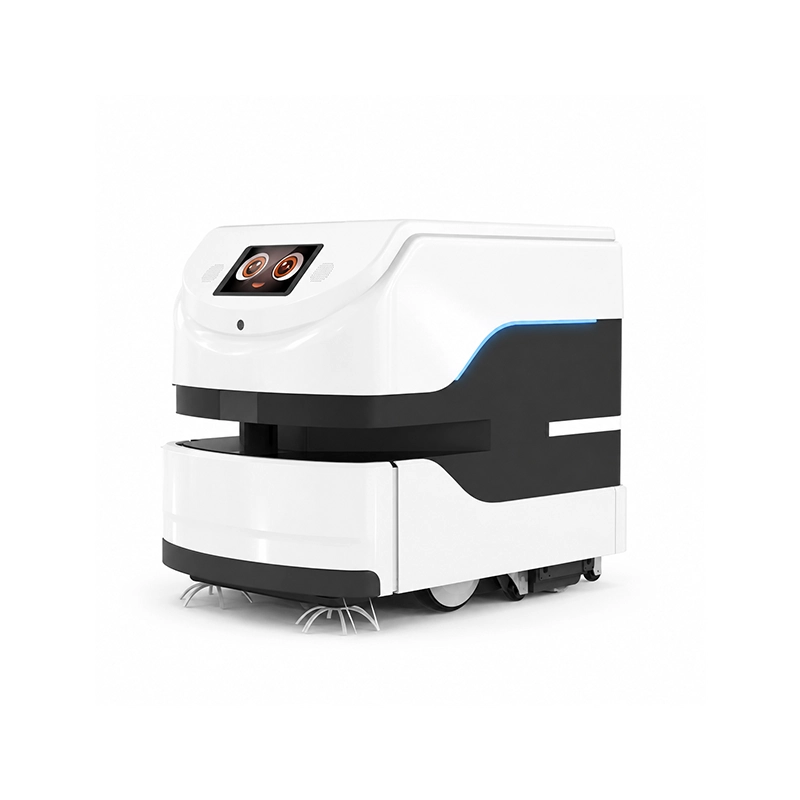
AIsirRobot Large-Area Commercial Cleaning Robot
An autonomous floor cleaning robot with 9-hour runtime, 40,000 m² LiDAR mapping, and 3D camera + LiDAR obstacle avoidance — built for large single-floor hard-floor facilities that require extended autonomous cleaning without a fixed docking station.



Product Overview
Large commercial floor areas — factory floors, shopping malls, hospitals, transit hubs — share three cleaning challenges: the area is too large for a single operator to cover consistently, labor costs for dedicated cleaning staff keep rising, and cleaning quality varies by shift and personnel. The AIsirRobot large-area commercial cleaning robot addresses this with an autonomous robotic floor cleaning machine that maps up to 40,000 m², runs for 6-10 hours per charge, and operates without a fixed automatic docking station.
The robot combines a 15L water tank with water circulation filtration, a high-polymer sponge roller, UV floor disinfection, and a bow-shaped wall-following cleaning path. A 3D camera and LiDAR sensor provide 270-degree obstacle perception. A cloud-based platform enables remote monitoring of robot status.
Key specifications at a glance:
|
Parameter |
Value |
|
Dimensions |
670 x 490 x 600 mm |
|
Water Tank Capacity |
15L |
|
Battery |
Lithium iron phosphate (LiFePO4) 25Ah / 38.4V |
|
Runtime |
6-10 hours per charge |
|
Charging Time |
Approximately 6 hours |
|
Cleaning Speed |
0.1-0.5 m/s |
|
Mapping Capacity |
Up to 40,000 m² |
|
Navigation |
3D camera + LiDAR, 270 degrees |
|
Minimum Passage Width |
900 mm |
 Photo
Photo
[Discuss Your Floor Cleaning Requirements]
Applications
This industrial floor cleaning robot is an autonomous cleaning solution designed for large indoor hard-floor areas where extended runtime, wide-area mapping, and reduced labor dependency are priorities.
Each scenario below follows the same structure: the cleaning pain point, how this robot addresses it, and what must be confirmed before deployment.
- Factory floors — Continuous production schedules require cleaning during short changeover windows. The robot provides autonomous bow-shaped path cleaning along walls and edges during non-production hours. Confirm that production aisles meet the 900 mm minimum passage width and that floor material is compatible with the sponge roller.
- Shopping malls — Large open areas with mixed floor layouts and non-business-hour cleaning windows. The robot supports scheduled weekly cleaning plans and cloud-based remote monitoring. Confirm water refill and drainage locations, and that cleaning routes do not require stair navigation.
- Hospitals — Regulated hygiene environments requiring consistent floor cleaning. UV floor disinfection provides a supplementary hygiene measure during the scrubbing pass. UV disinfection does not replace regulated chemical disinfection protocols. Confirm floor material compatibility and that cleaning schedules align with infection control procedures.
- Office buildings — Multiple zones with varying traffic levels and narrow time windows. Customizable cleaning area selection allows different frequencies for entrances, corridors, and open-plan areas. Confirm that corridor widths meet the 900 mm minimum and that threshold transitions are navigable.
- Transit stations and airports — High-traffic environments with variable obstacle patterns. The 3D camera and LiDAR provide 270-degree obstacle perception for autonomous navigation. Confirm that cleaning schedules avoid peak passenger flow periods and that platform edge detection is tested before deployment.
- Sports arenas and exhibition halls — Intermittent use patterns with large single-floor venues. The 40,000 m² mapping capacity supports large floor plans, and incremental mapping allows area expansion over time. Confirm that the venue floor is a single level and that the robot can be transported between halls if needed.
Site suitability should be verified using a floor plan, route-width check, and operating-condition review before final configuration.
Key Features
✅ High-Polymer Sponge Roller
The robot uses a high-polymer sponge roller that provides scrubbing action for hard-floor surfaces. The roller material is designed to clean without damaging standard hard flooring. Combined with the bow-shaped cleaning path, the roller helps reduce the redeposition of dirty water during a cleaning cycle.
Floor surface compatibility should be confirmed through a site assessment before deployment. The roller is designed for hard floors; suitability for specialty or delicate flooring materials must be verified.
✅ Bow-Shaped Wall-Following Cleaning Path
The robot follows a bow-shaped path along walls, designed to improve systematic route coverage and reduce missed areas along accessible walls and edges. The path adapts to the mapped floor plan rather than relying on random-pattern movement.
Actual coverage depends on floor layout, obstacle density, and the robot’s ability to access edges around fixed equipment or furniture. Areas behind obstacles narrower than the 900 mm minimum passage width cannot be reached.
✅ Extended Operation System: 15L Tank, Water Circulation, and 9-Hour Runtime
The robot integrates three features that support extended autonomous cleaning:
| Feature | What It Does | Deployment Limitation |
| 15L water tank | Holds sufficient water for extended cleaning cycles | Water refill must be arranged manually; no automatic docking station |
| Water circulation filtration | Filters water during operation to reduce refill frequency | Filtration capacity depends on floor soil level; heavily soiled floors may require more frequent water changes |
| LiFePO4 battery 25Ah / 38.4V | Provides 6-10 hours runtime per charge (approximately 9 hours typical) | Charging time approximately 6 hours via direct plug-in; no auto-docking charge |
LiFePO4 chemistry is selected for stable commercial operation. Specific cycle life data and safety certifications for this model are available on request.
This model does not require a fixed automatic docking station. However, water refill, waste-water handling, and plug-in charging must be arranged manually unless a different configuration is confirmed.
✅ UV Floor Disinfection
An ultraviolet lamp provides floor surface disinfection during the cleaning pass. This serves as a supplementary hygiene measure.
UV disinfection is a supplementary process. It does not replace established facility hygiene protocols or chemical disinfection procedures where regulated standards apply. UV lamp specifications (wavelength, intensity) for this model are available on request.
✅ 3D Camera + LiDAR Obstacle Perception (270 Degrees)
A 3D camera and LiDAR sensor work together to provide 270-degree obstacle perception. The 3D camera provides depth information for nearby obstacle perception, while LiDAR supports ranging, mapping, and path planning.
Specific object-recognition capabilities (e.g., obstacle classification, semantic identification) should be confirmed for the selected configuration. The 270-degree coverage means that a zone behind the robot may not be monitored during forward motion.
✅ 40,000 m² LiDAR Mapping with Cloud Platform
The robot supports LiDAR-based mapping of areas up to 40,000 m². This figure refers to mapping capacity, not guaranteed cleaning output per charge. Mapping supports remote map creation and incremental map expansion.
A cloud-based platform enables remote monitoring of robot operational status and cleaning progress. Specific platform features, data retention, and integration options are available on request.
✅ Scheduled Cleaning with Weekly Plans
The robot supports scheduled cleaning with customizable weekly plans. Cleaning tasks can be assigned to specific zones, days, and time windows — enabling autonomous operation outside business hours.
Scheduling flexibility depends on the number of zones mapped and the robot’s ability to transition between zones without manual relocation. Multi-floor scheduling requires physical relocation and re-mapping on each level.
✅ Pressurized Wet Scrubbing
Building on the high-polymer sponge roller’s scrubbing action, the robot applies pressurized wet scrubbing, combining scrubbing and residual-water recovery in a single cleaning pass. This means the robot scrubs and collects water in one forward motion, reducing the waiting time before the floor is walkable compared to traditional mopping that leaves visible wet trails.
Actual water recovery performance depends on floor material, cleaning speed, and soil level. Residual water may remain on textured or uneven surfaces.
Robot vs. Traditional Cleaning: What Changes for Your Facility
This robotic floor cleaning machine does not replace your entire cleaning team. It replaces the repetitive, time-consuming floor mopping and ride-on scrubber operation — and does it more consistently across larger areas. The robot still requires personnel for water handling, charging, exception handling, and routine maintenance.
| Factor | Manual Mopping | Ride-On Scrubber | AIsirRobot Cleaning Robot |
| Labor dependency | Dedicated cleaner required | Trained driver required | One operator monitors multiple units; manual water handling and charging still required |
| Route consistency | Varies by operator and fatigue | Varies by driver skill and route | Consistent path, speed, and coverage every cycle |
| Data recording | No operational data | No operational data | Cloud platform records robot status and cleaning progress |
| Water handling | Manual mop rinse and water changes | Manual tank fill and drain | 15L tank with circulation filtration reduces refill frequency; refill and drainage remain manual |
| Operating duration | Limited by operator stamina | Limited by driver shift length | 6-10 hours autonomous runtime per charge |
| Deployment conditions | Requires operator on-site | Requires driver and parking space | Requires 900 mm minimum passage width, manual water access, and plug-in charging location |
Suitable Floor Types
The robot is designed for indoor hard-floor surfaces. The high-polymer sponge roller provides scrubbing action for standard hard flooring materials.
Common candidate surfaces for evaluation include:
- Tile (ceramic, porcelain)
- Concrete (sealed)
- Vinyl and linoleum
- Stone (sealed marble, granite)
- Epoxy-coated floors
Compatibility with specific flooring must be confirmed before quotation. Surfaces requiring confirmation include unsealed stone, anti-static flooring, heavily textured surfaces, and floors with expansion joints or drainage channels.
Technical Specifications
FAQS
What floor types does this commercial cleaning robot support?
The robot is designed for hard-floor surfaces. Common candidate surfaces for evaluation include tile, sealed concrete, vinyl, sealed stone, and epoxy-coated floors. Compatibility with specific flooring must be confirmed before quotation.
How large an area can this robot map?
The robot supports LiDAR-based mapping of areas up to 40,000 m². This figure refers to mapping capacity, not guaranteed cleaning output per charge. Actual cleaning coverage per charge depends on route layout, cleaning speed, obstacle density, and soil level.
Does this robot require a base station or docking station?
This model does not require a fixed automatic docking station. However, water refill, waste-water handling, and plug-in charging must be arranged manually unless a different configuration is confirmed.
Can the robot clean multiple floors?
The robot uses LiDAR mapping for a single floor level. Multi-floor cleaning requires physical relocation and re-mapping on each level. The robot cannot climb stairs autonomously.
What is the difference between the 3D camera and LiDAR sensor?
For buyers comparing navigation systems, the practical implication is: the dual-sensor setup provides better obstacle perception than single-LiDAR robots, but the 270-degree coverage means you should plan cleaning routes to minimize reverse travel in obstacle-dense areas. Specific object-recognition capabilities should be confirmed for the selected configuration.
How does water refilling work?
The 15L water tank supports extended cleaning cycles. Water circulation filtration reduces refill frequency. However, water refill and waste-water drainage must be arranged manually — this model does not have an automatic water exchange station.
What warranty and support are included?
A 12-month warranty covers the robot. Lead time is approximately 35 days. MOQ is 1 unit. After-sales coordination is available through AIsirRobot support channels for troubleshooting and replacement parts.
Can this robot be integrated with our building management system?
The robot operates as a standalone unit with cloud-based remote monitoring. Building management system integration, access control integration, and IoT platform connectivity are subject to interface confirmation.
Request a Quote or Technical Evaluation
Tell us what you need the robot to do. Even if some technical details are not yet confirmed, our team can help evaluate suitable options.
- Application: Briefly describe the task, workflow, or problem you want the robot to handle.
- Key requirements: Share any known payload, reach, capacity, runtime, accuracy, speed, or other performance needs.
- Site & integration: Tell us about the operating environment, layout, existing equipment, or software interfaces if relevant.
- Quantity & timeline: Let us know the expected quantity, destination country, and target delivery or deployment time.