Contact Us



AIsirRobot Hospital Delivery Robot: How It Works, What It Solves, and How to Deploy
AIsirRobot Hospital Smart Delivery Robot is an autonomous indoor delivery solution for hospitals, enabling secure transport of medications, specimens, meals, and supplies with QR code access, laser navigation, obstacle avoidance, and autonomous elevator integration.



Product Overview
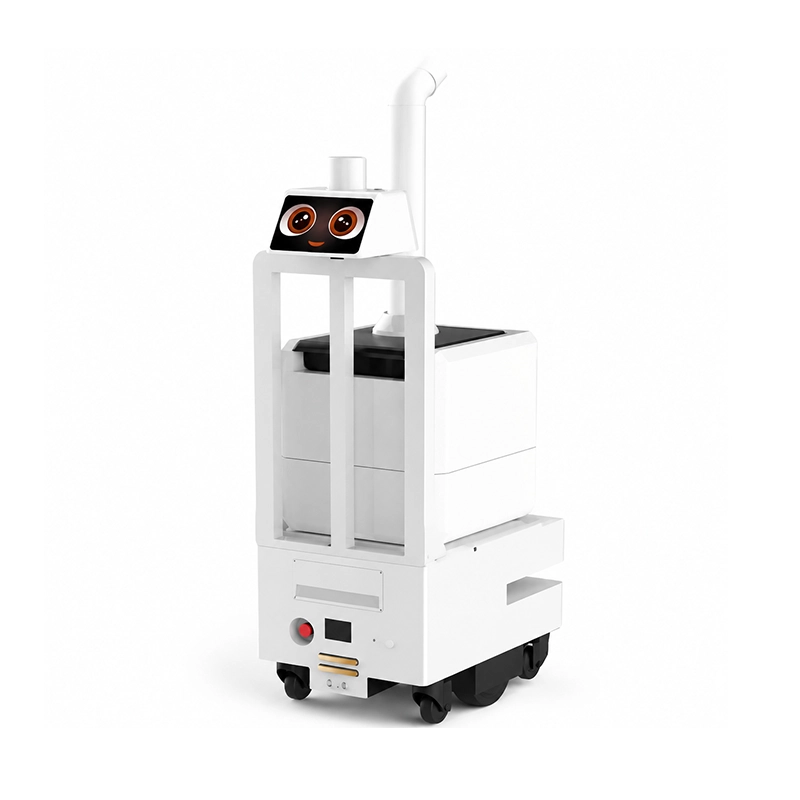
The robot features a vertical cylindrical design with smooth, rounded contours and no sharp edges — reducing collision risk in busy hospital corridors. The main body is finished in white, with a black top section housing the 7-inch touchscreen, 3D camera, and speaker. Light blue accent strips provide a clear visual signal of the robot’s position in dimly lit corridors.
A QR code scanner on the front panel handles cabin access verification. An emergency stop button is located on the front panel for immediate shutdown. The white base houses omnidirectional wheels enabling zero-degree rotation in place. The robot weighs approximately 60 kg and measures 500 × 500 × 1,170 mm — a compact footprint designed for standard hospital corridors and elevator interiors.
 Photo
Photo
Key Features
Application Scenarios

Nursing Stations
Secure delivery of medical items and supplies

Pharmacy & Lab
Transport of medicines and specimens

Meal & Supply Delivery
Multi-tier delivery for meals and hospital supplies
Integration Capabilities
The robot connects via WiFi and supports integration with hospital systems. The following integration capabilities are commonly supported in similar robotic systems. Actual availability and compatibility depend on your specific facility systems and require individual assessment. Common integration points include:
- Elevator systems: Autonomous elevator calling for cross-floor delivery (depends on elevator model and API availability)
- Door and gate access: Automated passage through access-controlled areas (requires compatible hardware)
- Cloud platform: Remote fleet monitoring, delivery log access, and performance data across multiple departments or facilities
- Hospital information systems: Delivery task triggering based on order or request data (depends on system compatibility)
Integration scope and compatibility depend on the specific systems in use at your facility. We can help assess integration feasibility during the site evaluation phase.
Buyer Guide: Is This Robot Right for Your Facility?
Before requesting a quotation, review the following checklist to assess whether this model fits your operational needs:
| Question | Why It Matters |
| Do your corridors accommodate a 500 × 500 mm footprint? | The robot requires clear passage width of at least 500 mm. Measure your narrowest corridor points, including doorways and elevator entrances, to confirm compatibility. |
| Do you need cross-floor delivery? | If yes, elevator compatibility assessment is required. If all deliveries are on a single floor, elevator integration is not needed. |
| Do you need verified item access? | If chain-of-custody records are required for medications or specimens, QR code-verified access provides this capability. |
| What is your daily delivery volume? | Helps determine whether a single robot or a multi-robot fleet is needed. |
| Do you have a fixed location for the charging station? | The station needs a dedicated spot with power access and docking space. |
| What item types will the robot transport? | Medications, specimens, meals, and linens have different contamination control and regulatory requirements. |
| Are your facility’s pharmacy, infection control, and risk management teams available for planning input? | Their involvement ensures deployment aligns with internal policies and applicable regulations. |
If you answered yes to most of these questions, this robot is a strong candidate for your facility. Contact us to schedule a site assessment and receive a tailored configuration recommendation.
Technology and Specification Guide
FAQS
Q: How does the QR code access system work?
Each cabin tier is locked by default. Staff scan a QR code at the scanner on the front panel to unlock the corresponding tier. Different tiers can be assigned to different recipients, allowing multi-stop delivery with per-tier access control. QR code generation and management should be integrated into the facility’s existing workflow.
Q: Can the robot deliver items to different floors?
Yes. The robot can autonomously call elevators and control access doors through IoT connectivity. Cross-floor delivery depends on the elevator model and door system installed at the facility. We assess elevator and door compatibility during the site evaluation.
Q: How long does the battery last, and how does charging work?
Battery life is 15 to 20 hours per charge. The robot autonomously navigates to a dedicated charging station when battery levels are low and charges during idle periods. With idle-time charging between delivery tasks, the robot can support near-24-hour operation depending on delivery volume and charging intervals. The charging station must be installed in a fixed, accessible location with adequate space for docking.
Q: What are the environmental requirements for operation?
The robot operates in temperatures from 5°C to 40°C with humidity from 5% to 85%. For storage, the temperature range is -10°C to 50°C. At extreme storage temperatures, the battery requires at least one charge-discharge cycle per month. These parameters should be verified against your facility’s environmental conditions.
Q: Can the robot handle medical specimens and medications?
The enclosed cabin design supports contamination control during transit by separating contents from the corridor environment. However, actual suitability for specific medication or specimen types depends on your facility’s transport protocols and applicable regulatory requirements. We recommend consulting your pharmacy and infection control teams during the planning phase.
Q: What is included in the warranty?
The 12-month warranty covers manufacturing defects in hardware components, including the battery, motors, sensors, touchscreen, and electric door mechanisms. Consumable parts such as cabin trays are covered for normal wear under standard use. For full warranty terms, please contact us with your project requirements.
Request a Quote or Technical Evaluation
Tell us what you need the robot to do. Even if some technical details are not yet confirmed, our team can help evaluate suitable options.
- Application: Briefly describe the task, workflow, or problem you want the robot to handle.
- Key requirements: Share any known payload, reach, capacity, runtime, accuracy, speed, or other performance needs.
- Site & integration: Tell us about the operating environment, layout, existing equipment, or software interfaces if relevant.
- Quantity & timeline: Let us know the expected quantity, destination country, and target delivery or deployment time.