

 Contact Us


 Home /
Cleaning Robot Edge Coverage: Corners, Baseboards, Furniture, and Manual Finishing
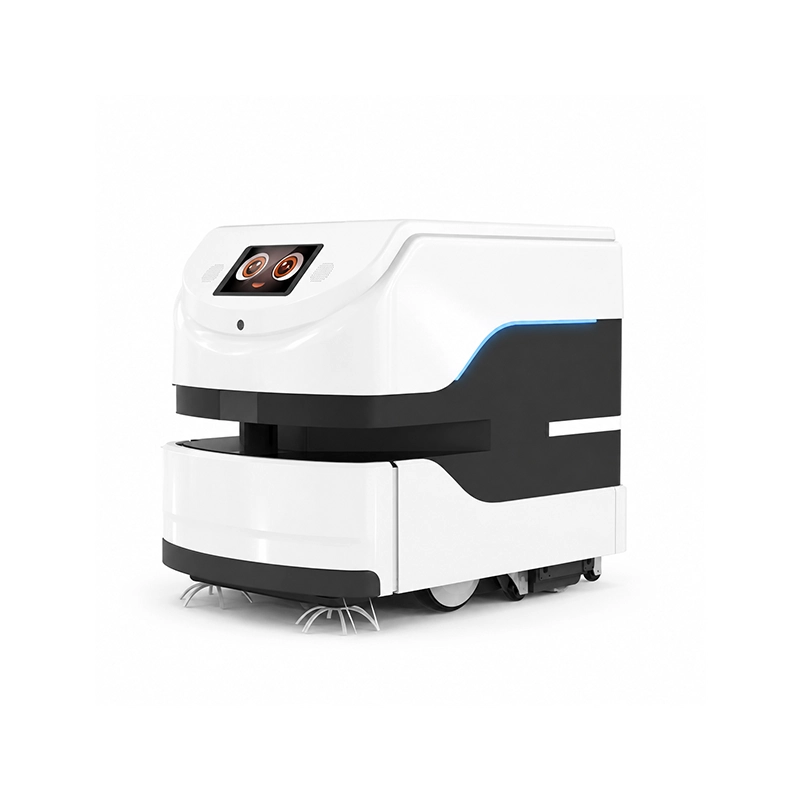
Cleaning Robot Edge Coverage: Corners, Baseboards, Furniture, and Manual Finishing
Oct 13, 2026

Parallel vs Angular Robot Grippers: Access, Stroke, and Finger Envelope
Oct 13, 2026

Empty Pallet Supply for Robotic Cells: Dispensers, Stackers, and AMR Replenishment
Oct 13, 2026

Robot Simulation Deliverables: URDF, Collision Models, Limits, and Hardware Gaps
Oct 13, 2026
A cleaning robot can log a hundred percent route coverage and still leave a dirty strip along every wall. Coverage and cleaning are different things, and the difference shows up at the edges. The machine passed over the floor, but the brush did not touch the baseboard, the corner, or the floor under the low shelf. If the site plans on the robot cleaning the whole area, it will be disappointed at the edges, and the disappointment will arrive after the purchase. The honest approach is to measure what the robot cleans, and to plan the manual finishing for what it does not.
Define the Cleanable Boundary
The cleanable area is not the area the machine passes over; it is the area its cleaning mechanism actually contacts.
The broader commercial cleaning robots overview compares cleaning tasks and navigation; this page measures the residual edge work left by a selected machine.
A scrubber or vacuum reaches the floor through a brush, a pad, or a suction head that sits some distance from the machine's outer body. That offset means the machine can drive its body flush against a wall and still leave a strip of floor untouched, because the cleaning mechanism could not reach the last few centimeters. The cleanable boundary is set by the machine's envelope, the position and width of the cleaning mechanism, and the obstructions it cannot pass.
Write down the machine's outer dimensions, the position of the brush or head relative to the body, and the resulting offset. Then compare that with the floor plan. The residual edge strip is determined by the effective reach of the active brush, pad, or suction head in the selected mode, plus how closely the robot can approach obstacles. Measure that strip for the actual model and operating mode rather than inferring it from body width alone. Do not confuse "the robot went there" with "the robot cleaned there." The boundary is a physical fact about the machine, and it is the first number to establish.
Classify Corners and Obstructions
Edges are not one category, and different edge types need different handling.
An inside corner, where two walls meet, is the hardest for a round machine, because the cleaning mechanism cannot reach into the vertex. An outside corner, on a column or a partition end, is easier to pass but still leaves a strip. A baseboard runs along the wall, and the floor strip in front of it is typically uncovered. A column base or a pipe floor flange interrupts the pass around an obstacle. Low-hanging furniture, such as a bench or a display stand, limits how close the machine can get and whether it can pass underneath. A gap or a crack between floor sections is a different problem again, because the cleaning mechanism may bridge it rather than clean it.
Make a list of the edge types on your site and count them. Count and map the edge types, then measure the residual length, width, soiling level, and access difficulty. Those observations—not corner count alone—are the inputs for a realistic manual-finishing workload. Classify them by geometry, not by how they look: an inside corner and a column base are different tasks even if both are "corner-ish." This list becomes the map of what the robot covers and what a person covers.
Measure the Uncleaned Strip
The size of the uncleaned strip is a site measurement, not a catalogue number.
The strip depends on the machine's offset, the edge type, and how well the machine can position against that edge. Because those vary by machine and by site, the right method is an observation you can repeat. Run the machine along a representative wall and look at the floor in front of the baseboard. Do the same at an inside corner, an outside corner, a column base, and under a low shelf. Note where the floor is still dirty after the pass, and how wide the dirty strip is.
Use a repeatable method so the results are comparable: the same route, the same starting dirt, the same lighting, and a photograph of each edge type after the pass. Do not adopt a universal millimeter figure, because the machine, the brush, and the edge all change the number. The value of this measurement is that it turns "the robot leaves some edges" into a list of specific zones with specific widths, which is what a manual finishing plan needs. It also gives you a before-and-after comparison if you change the machine or its settings.
Plan Manual Finishing Routes
Once the uncleaned zones are known, they become a manual task with an owner, a frequency, and a route.
A cleaning operation already has staff, and the robot does not remove the need for a person at the edges; it changes which edges. Convert the uncleaned strips into a finishing route: which zones a person cleans after the robot, in what order, and how often. An edge along a main corridor may need finishing every day, while a corner behind a display may need it weekly. Assign each zone to a person and a frequency, and estimate the time. That estimate is the honest answer to "how much does the robot clean," because the total is the robot's area plus the manual finishing.
Do not claim full coverage. The useful statement is that the robot cleans the open floor and that a person finishes the edges, with the list of edges and the time it takes. This is a work plan, not a marketing number, and it is what makes the deployment predictable. A person who knows which edges to finish can work efficiently; a site that assumed no edges would be left will discover them one by one.
Compare Edge Accessories and Trade-Offs
Some machines offer edge accessories, and they change the boundary, so they are worth checking specifically.
An edge brush that extends out to the side, or a mechanism that lowers to sweep along a wall, can reduce the uncleaned strip, but only within its own limits. Some commercial floor-cleaning robots use offset, side, or extendable brushes, but edge performance depends on the model and the operating mode. Kärcher describes the KIRA B 50's side brush as extending cleaning close to edges, a model-specific mechanism rather than a universal result. Obtain the floor-cleaning manufacturer's model-specific brush reach and mode behavior, then confirm residual width at straight walls, corners, and furniture bases on site.
Check the mechanism against your edge types. An edge brush helps along a straight baseboard and may do little in an inside corner. A lower brush may reach under a low shelf or may not. Ask the supplier for the mechanism's dimensions, its travel, and the site conditions it requires. Where an edge accessory has different modes, measure its performance in each mode used at your site; do not treat a mode label as proof that the entire edge is cleaned. Where a specific model's edge data is not published, plan a site test, because the accessory's effect on your floor is the only number that matters.
Report Net Coverage and Rework
The measure that counts is net coverage: what the robot cleaned, what remained, and how long the manual finishing took.
Record three things together. First, record the zones where the cleaning head actually worked and the surface passed your cleaning check; keep route coverage and residual-strip observations as separate measures. Second, the residual zones, the specific edges and obstacles the robot left. Third, the manual time to finish those zones. The sum of the robot's cleaning and the person's finishing is the site's actual coverage, and it is a fairer number than the robot's route coverage.
For reporting beyond a single floor zone, the robot fleet KPI guide defines broader availability and cost-per-task measures; edge-strip observations remain a separate cleaning-quality input.
Keep this record as the basis for comparing machines and for adjusting the deployment. If a machine change or an accessory reduces the residual zones, the manual time drops, and that shows in the record. If it does not, the record proves it. This is the point where cleaning becomes measurable: not a theoretical area rate, but the observed division between what the robot does and what a person still has to do.
Measure the dirty edge before comparing cleaning-robot coverage figures. Mark a representative wall, inside corner, column and low-furniture location on your floor plan, then add the observed residual strip and current manual touch-up time. Send that zone map for an application assessment. We can help translate it into model-comparison questions about active brush reach, operating modes and the manual work each configuration leaves behind.
Share on Social:


- PREV: Parallel vs Angular Robot Grippers: Access, Stroke, and Finger Envelope
- NEXT: Not NEXT
Contact Us
In This Article
Cleaning Robot Edge Coverage: Corners, Baseboards, Furniture, and Manual Finishing
Oct 13, 2026
Parallel vs Angular Robot Grippers: Access, Stroke, and Finger Envelope
Oct 13, 2026
Empty Pallet Supply for Robotic Cells: Dispensers, Stackers, and AMR Replenishment
Oct 13, 2026
Robot Simulation Deliverables: URDF, Collision Models, Limits, and Hardware Gaps
Oct 13, 2026