

 Contact Us

 Home /
 AMR vs. Fixed Conveyors: How to Choose by Flow Stability, Transfer Points, and Change Frequency
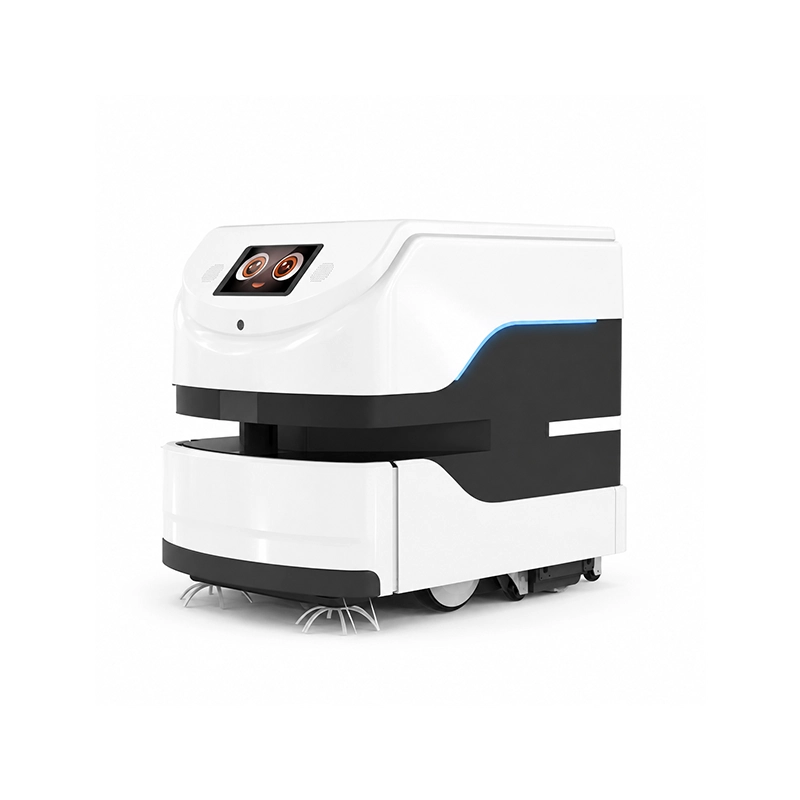


The AMR vs. conveyor comparison often gets simplified to “flexible vs. efficient” or “modern vs. legacy.” That framing hides the real decision variables.
The real choice: do you need a stable, fixed-path material flow (conveyors excel here), or a transport system that adapts to route changes, multiple destinations, and dynamic priorities (AMRs excel here)?
This is not a binary choice. Many optimal solutions are hybrid: fixed conveyors handle long-distance stable trunk lines, while AMRs handle the last few dozen meters of flexible delivery.
Flow Stability and Takt Requirements
Fixed conveyor flow characteristics:
- Flow is stable and predictable — conveyor runs at constant speed.
- Takt is consistent — even intervals between material arrivals.
- Throughput ceiling is clear — determined by speed and width.
- Conveyor bottlenecks include accumulation limits, jams, and merge/sortation constraints — material flow is not always congestion-free.
AMR flow characteristics:
- Flow is affected by traffic management — multi-robot crossings, path conflicts, and charging interruptions all affect actual throughput.
- Takt is variable — material arrival intervals to the same destination may be uneven.
- Throughput ceiling depends on fleet size, path planning, and dispatching efficiency.
- Peak periods may need more robots — but during low periods, robots can idle or handle other tasks.
Decision framework:
| Flow requirement | Conveyor fit | AMR fit | Notes |
| Constant high flow | Advantage | Needs large fleet | Conveyors are more cost-efficient at stable high flow — the specific threshold depends on your layout and item dimensions |
| Variable flow | Conveyor idles during low periods | Can be reassigned | AMR flexibility shows in variable flow |
| Multiple destinations | Needs sortation + branches | Each robot independent destination | Multi-destination is AMR’s core advantage |
| Single destination high flow | Advantage | May need multi-robot queuing | Single-destination high flow is conveyor’s ideal scenario |
Transfer Points, Accumulation, and Buffering
Conveyor buffering:
- Conveyor systems may provide accumulation depending on conveyor type and design — material can queue on the belt or in accumulation zones.
- When downstream is blocked, the conveyor may continue receiving upstream material within its accumulation capacity — but accumulation limits vary by conveyor type.
AMR buffering:
- AMR systems may use robot-held load, queueing, staging areas, or buffer stations to manage flow.
- When downstream is blocked, AMRs may wait, reroute, or stage material at a buffer position — the specific behavior depends on dispatching configuration and available staging space.
Key difference: Conveyor buffering and AMR buffering work on different principles — conveyors may provide linear accumulation, while AMRs use discrete staging and queueing. Both have buffering limits — the specific capacity depends on the system design.
Layout Changes and Product Mix Variations
Conveyor layout rigidity:
- Path is fixed after installation — changing routes requires dismantling and reinstallation.
- Adding destinations requires adding branches and sortation — high cost and engineering effort.
- If product mix changes alter the material flow path, the conveyor needs retrofitting.
AMR layout flexibility:
- Paths are software-defined — changing routes only requires updating the map and tasks.
- Adding destinations only requires adding a docking position and path — no physical changes.
- Product mix changes are handled by the dispatching system adjusting task assignments.
Change frequency is a key decision variable:
- If material flow paths will not change for the foreseeable life of the line — conveyor rigidity is not an issue.
- If layout adjustments, new product lines, or process changes happen regularly — AMR flexibility has enormous value.
- Temporary changes (seasonal, project-based) — AMRs can be deployed and withdrawn; conveyors cannot.
Footprint and Crossing Impact
Conveyor footprint:
- Conveyors occupy fixed floor space — even when not running, the space cannot be used for other purposes.
- Conveyors block crossing — personnel and forklifts need to detour or use crossover bridges.
- Support structures and frames take up space.
AMR footprint:
- AMRs occupy aisle space while running, and can park at charging stations when idle.
- Aisles can be shared with pedestrians (with safety limits).
- But AMRs need charging stations, staging areas, and maintenance space.
| Footprint dimension | Conveyor | AMR |
| Fixed footprint | Large (entire path length) | Small (charging + staging) |
| Aisle occupancy | Continuous | Intermittent |
| Crossing capability | Needs bridges or detours | Can yield to pedestrians |
| Space flexibility | Fixed | Reconfigurable |
Failure Modes: Comparing Failure Domains and Recovery Architecture
Conveyor failure characteristics:
- A section failure can stop the entire line — the failure domain depends on the conveyor layout and bypass options.
- Recovery requires on-site mechanical or electrical repair.
- Fallback options are typically limited — backup conveyors are rare.
AMR failure characteristics:
- A single AMR failure affects only that unit’s tasks — other AMRs can continue or absorb the workload.
- Recovery can involve dispatching a backup AMR or manual substitution.
- But systemic failures (dispatching system, network, WMS) can affect the entire AMR fleet — the failure domain is different from a mechanical conveyor failure.
Key difference: Compare failure domains and recovery architecture for your specific layout — do not assume one approach inherently has a larger or smaller blast radius. Conveyor failure is typically physical and localized; AMR failure is typically unit-level but with software/network dependencies that can create system-level failure modes.
Hybrid Architecture: Fixed Trunk + Mobile Last Mile
The optimal solution is often hybrid:
Fixed trunk: Conveyors handle long-distance, high-flow, fixed-path transport (e.g., main line from receiving to storage).
Mobile last mile: AMRs handle the final few dozen meters of flexible delivery (e.g., storage to individual workstations, workstation to staging).
Hybrid advantages:
- Leverages conveyor’s high-flow strength — trunk line flow is stable and high.
- Leverages AMR’s flexibility — last mile has multiple destinations and dynamic priorities.
- Reduces AMR fleet size — AMRs only cover the last mile, not long distances.
- Reduces conveyor retrofitting — trunk is fixed, last mile is flexible.
Hybrid transfer points:
- Conveyor-to-AMR transfer — needs roller/belt docking positions.
- AMR-to-conveyor transfer — same, needs powered transfer.
- Buffering and priority at transfer points — conveyor feeds continuously, AMRs need to pick up in time.
Flow Stability Decision Framework
Decision Matrix by Flow Pattern
| Evaluation dimension | Your situation | Conveyor fit | AMR fit | Hybrid fit |
| Flow | ||||
| Peak flow (items/h) | _____ | High-flow advantage | Needs large fleet | Trunk conveyor + last-mile AMR |
| Flow stability | ☐ Constant ☐ Variable | Constant advantage | Variable advantage | — |
| Route | ||||
| Route count | ☐ Single ☐ Multiple | Single-route advantage | Multi-route advantage | — |
| Route change frequency | ☐ Low ☐ High | Low-frequency advantage | High-frequency advantage | — |
| Route length | _____ | Long-distance advantage | Short-medium distance | Hybrid |
| Buffering | ||||
| Downstream blockage frequency | _____ | Built-in buffer | Needs staging | Hybrid |
| Staging space available | _____ | Not needed | Needed | — |
| Footprint | ||||
| Available floor space | _____ | Large footprint | Small footprint | — |
| Crossing needs | ☐ High ☐ Low | Blocks | Can yield | — |
| Fault tolerance | ||||
| Single-point failure impact | ☐ Large ☐ Small | Large | Small | — |
| Fallback options | _____ | Limited | Dispatch backup | — |
| Changes | ||||
| Layout change frequency | ☐ Low ☐ High | Low frequency | High frequency | — |
| Temporary needs | ☐ Yes ☐ No | Not applicable | Can deploy temporarily | — |
AMR, Conveyor, or a Hybrid?
The right architecture depends on flow stability and change frequency. We can help map the fixed and flexible parts of your material flow before you commit to equipment.
Please share, if available: flow rate, route length, number of destinations, buffer points, layout-change frequency, available floor space, and peak operating pattern.
Review Your Material FlowArchitecture Selection Inputs
- Not about advanced vs. traditional — it is about flow stability and route change frequency — constant high flow favors conveyors, variable multi-destination favors AMRs.
- Buffering works differently — conveyors have built-in buffering, AMRs need staging areas.
- Footprint is a hidden conveyor cost — fixed occupancy of the entire path’s floor space.
- Failure modes differ — conveyor single-point failure has large impact, AMR has distributed failure but system-level single points.
- Hybrid is often the best solution — fixed trunk + mobile last mile leverages each system’s strengths.
- Change frequency is the key variable — paths unchanged for the foreseeable future suit conveyors, frequent changes suit AMRs.
- No generic TCO winner — cost should be calculated based on actual layout and operating scenarios.
Share on Social:


