

 Contact Us


 Home /
Reception Kiosk vs Mobile Guide Robot: When Does Mobility Add Real Value?
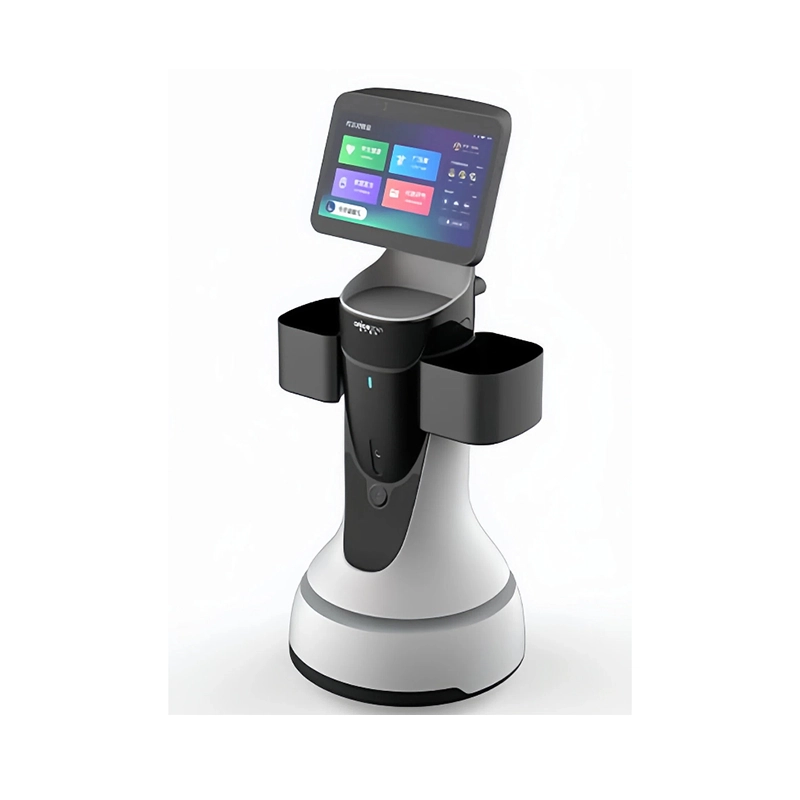
Reception Kiosk vs Mobile Guide Robot: When Does Mobility Add Real Value?
Oct 14, 2026
Cleaning Robot Filtration: Filter Ratings, Whole-Machine Leakage, and Dust Restrictions
Oct 14, 2026
Robotic Weld Inspection: Visual Checks, NDT, and What Camera Images Cannot Prove
Oct 14, 2026

Autonomous Trailer Loading: When Warehouse AMR Capability Is Not Enough
Oct 14, 2026
A reception kiosk and a mobile guide robot can both greet a visitor, answer a question, and point the way to the right office. On a trade-show floor the robot draws the crowd and the kiosk looks like furniture. In a real lobby on a busy morning the two behave very differently, and the choice between them is rarely about which one is more impressive. It is about whether mobility earns its cost for the task you actually need done.
That is the question this article works through. It treats the kiosk and the moving robot not as product categories but as two service architectures, and it asks the buyer to start from the visitor's task rather than the machine's novelty. The sequence is: specify the task, compare fixed and mobile service points, account for congestion and route limits, check content and system dependencies, measure whether the service actually completes, and then choose fixed, mobile, or a hybrid.
Specify the Visitor Task
"Do you need a reception robot?" is the wrong opening question, because "reception" bundles tasks that have almost nothing in common. Split them apart first.
Looking up information: where is room 3B, when does the next tour start, is the office open today. This is a retrieval task, and it is usually served perfectly well by a fixed screen.
Remote connection: reaching a specific person, a security desk, or a translator. This is a routing and communication task.
Registration and check-in: capturing a name, issuing a badge, confirming an appointment. This is a data-entry task with identity and privacy implications.
Escorting: physically leading a visitor to a location. Of these tasks, physical escort is the clearest reason to use a moving machine: the deliverable includes accompanying the visitor along a route.
Bundling all four into one purchase is how organizations end up paying for mobility they never use. A kiosk does retrieval, routing, and registration well. Escorting most clearly requires movement; approaching visitors at separate service points may also justify it when the site's visitor-flow data supports that need. Name the dominant task first, and the architecture question mostly answers itself before a single quote is requested.
Compare Fixed and Mobile Service Points
Once the task is named, the trade-off becomes concrete, and it is rarely a simple upgrade.
A fixed kiosk has three structural advantages. It is always in the same place, so visitors can find it again. It can be wired for power and network, so it does not depend on a battery or a reliable Wi-Fi handoff. And it has no route to plan, no floor to learn, and no one to block its path. For a known location with predictable footfall, its reach is exactly where it is installed, and that is often enough.
A mobile robot's advantage is reach. It can go to the visitor instead of waiting for the visitor to come to it, and it can accompany them, which is a real service when the destination is hard to find or the visitor is unfamiliar with the building. That reach is bought with dependencies: a battery, a map of the site, sensors that hold up in the actual lighting and crowd density, and a maintenance plan for a machine that moves.
The mistake is to assume the mobile option is strictly better. It is better only when the task's deliverable is movement or proximity. For a retrieval or check-in task in a fixed location, mobility adds cost, failure modes, and daily operational load without adding service. Match the architecture to the task, not to the demo.
Account for Congestion and Route Limits
Mobility sounds simple until the lobby fills up. A guide robot has to operate in the real conditions of the site, and those conditions are constraints, not details.
How dense does foot traffic get at peak, and does the robot have a path that stays clear? Where are the pinch points, the doors it must pass, the elevators it might need, the stairs it cannot use? What happens when a group blocks its route, or when a child stands in front of it? A robot that can navigate an empty hall may be unable to make progress at the ten-minute mark of a busy morning.
There is also the matter of the human alternative. Most sites already have a staffed desk or a greeter. The robot does not operate in a vacuum; it operates in a space where human help is usually available and often preferred when the situation is unusual. Any plan for a mobile robot should state explicitly how it behaves when the crowd is dense, when the route is blocked, and when a human should take over. Autonomy claims made in a controlled demonstration do not transfer automatically to a live lobby, and the buyer should treat congestion and routing as first-class design inputs rather than afterthoughts.
Review Content and System Dependencies
A service point is only as useful as the information behind it, and that information does not maintain itself.
Content: who updates the answer database, the event schedule, the directory, and the multilingual strings, and how often? A kiosk with a stale directory is worse than a printed sign, because visitors trust it and it misleads them.
Interfaces: does the service point need to talk to a booking system, a badge printer, an access-control system, or a calendar? Each interface is a dependency that can fail independently, and each one needs an owner.
Language: which languages must be supported, at what quality, and who is accountable for the translations being correct and current?
Network: does the device need a live connection to be useful, and what does it do when the connection drops? A mobile robot that loses its network mid-escort and cannot complete the route has turned a service into a stranded visitor.
Performance must be verified by model, not by category. Two robots in the same product line can have very different duty cycles, sensor suites, and content pipelines. Ask for the specification of the specific unit, and confirm that the content and interface work is included in the scope, not assumed to happen later.
Measure Useful Service Completion
The number that matters is not how many people stopped to look at the robot. It is how many visitors got what they came for.
Define a completed service for each task: for retrieval, the visitor found the answer without asking a human; for escorting, the visitor arrived at the intended destination; for check-in, the visitor was registered and badged correctly. Then measure that. Attendance at a demo, dwell time, and photo count are measures of novelty, and novelty decays.
There is published evidence that the useful deployment of service robots depends on far more than the robot itself. A study of hotel service robots found that acceptance in real settings depends on a combination of robot, human, and organizational conditions, not on the technology alone. The HOSPER hospital-reception study protocol identifies offline vocabulary and update limits, and explains that its controlled setup does not reproduce a busy lobby's noise and congestion. The lesson for a buyer is not which robot to buy. It is that "does the service complete" is an empirical question that has to be tested in the actual setting, and that reliability and offline behavior are part of the answer.
The market itself reflects how the task drives the architecture. OrionStar markets the BaoXiaoMi 2 for reception, wayfinding and interactive guidance, and its own product specifications describe navigation and travel. UBTECH positions Walker C as a mobile humanoid for reception and guided interactions. These are mobile service designs, not evidence that BaoXiaoMi 2 is a stationary-kiosk benchmark. A fixed kiosk is a separate architecture that should be assessed on service completion, site demand and operating cost. A buyer comparing them by feature list rather than by the task they have to complete will pick the wrong architecture.
So build a small service-completion test into any pilot: real tasks, real visitors, and a count of how many were finished without human rescue. That number, not the crowd size, is what justifies or kills the purchase.
Choose Fixed, Mobile, or Hybrid
The output of this process is a decision at the level of the task, not the device.
If the dominant task is retrieval, registration, or basic routing in a known location, a fixed kiosk is the low-cost, low-risk choice, and a well-designed kiosk may outperform a robot on the metrics that matter.
If the deliverable is genuinely escorting, or reaching visitors who cannot or will not come to a fixed point, mobility earns its keep, and the plan should own its dependencies openly.
And the honest answer for many sites is a hybrid: a fixed service point for the common, quick tasks, a small number of mobile units for escorting and for high-traffic periods, and a staffed desk that handles anything unusual. Keeping the human in the loop is not a failure of automation; it is a design decision that protects the visitor experience when the robot reaches its limits.
The buyer who works the sequence in this order spends the automation budget on the task that actually needs it, and stops paying for mobility that only ever looked impressive in a showroom.
Map the Reception Task Before Buying Mobility
List the visitor tasks, floor plan, peak arrival pattern, escort destinations and how visitors can reach a person. AIsirRobot can compare the preliminary fit of fixed terminals, mobile guide robots and a hybrid workflow against those requirements, then identify the model and site questions still needing a trial. Start a reception application assessment.
Share on Social:


Contact Us
In This Article
Reception Kiosk vs Mobile Guide Robot: When Does Mobility Add Real Value?
Oct 14, 2026
Cleaning Robot Filtration: Filter Ratings, Whole-Machine Leakage, and Dust Restrictions
Oct 14, 2026
Robotic Weld Inspection: Visual Checks, NDT, and What Camera Images Cannot Prove
Oct 14, 2026
Autonomous Trailer Loading: When Warehouse AMR Capability Is Not Enough
Oct 14, 2026