Contact Us



1,500 kg Autonomous Stacker Forklift | 2,585 mm Lift Height
The AIsirRobot is an autonomous stacker forklift designed for warehouses, distribution centers and production logistics facilities that need to move and stack heavy pallets without a dedicated operator on each vehicle. It handles pallets up to 1,500 kg, lifts to a maximum height of 2,585 mm, and navigates using real laser SLAM — no reflectors, magnetic strips or QR codes required.



Product Overview
The is an autonomous stacker forklift built for high-load pallet handling in industrial environments. It performs driverless stacking, retrieval and transport tasks using onboard navigation and a multi-layer safety system.
What it is: A self-navigating electric stacker forklift with electronic steering and AC servo motor drive.
Who it is for: Warehouse operators, logistics managers, production facility planners and automation integrators who need to reduce repetitive manual forklift handling in pallet-intensive workflows.
What it does: Moves, stacks and retrieves pallets up to 1,500 kg across floor-level and rack-level positions, navigates narrow aisles, travels between floors via elevator, and charges automatically between tasks.
The robot operates in both autonomous and walk-behind manual modes. In autonomous mode, it navigates, locates pallets, engages forks, transports loads and returns to charge without operator intervention. In manual mode, an operator can drive the robot using walk-behind controls for tasks that require direct human control.
 Photo
Photo
Key Benefits
✅1,500 kg Payload with 2,585 mm Lift Height
The handles pallets up to 1,500 kg and lifts them to a maximum height of 2,585 mm. This covers standard one-tier and two-tier racking configurations in most warehouse environments. Actual lift capacity at full height should be verified against the load center distance (500 mm) and the specific pallet configuration in your facility.
✅1,500 mm Turning Radius for Narrow Aisles
A 1,500 mm turning radius allows the to operate in aisles as narrow as 2,100 mm (for 800 × 1,200 mm pallets placed along forks) or 2,200 mm (for 1,000 × 1,200 mm pallets placed across forks). This makes it suitable for facilities where aisle width was not originally designed for automated guided vehicles. Actual aisle requirements should be confirmed against your pallet dimensions and storage layout.
✅Real Laser SLAM — No Infrastructure Modifications
The robot navigates using real laser SLAM technology. No reflectors, magnetic strips or QR codes need to be installed on the floor or walls. This reduces deployment time and eliminates ongoing maintenance of navigation markers. Map updates can be performed when the facility layout changes. Navigation performance depends on the environment having sufficient geometric features for the LiDAR to reference; facilities with long featureless walls may require additional mapping support, such as conducting a remapping session or adding reference markers to improve LiDAR feature recognition.
✅3D Pallet Recognition for Precise Fork Engagement
A 3D pallet recognition system allows the robot to identify pallet position and orientation, then adjust its approach to engage the forks accurately. This reduces the need for pallets to be placed in fixed positions and supports operations where pallet locations vary between cycles. Recognition performance depends on pallet condition, lighting and the presence of obstructions around the pallet entry points.
✅Cross-Floor Operation via Elevator
The is designed to travel between floors using standard freight elevators. This enables autonomous pallet transport across multi-level warehouses without manual transfer at each floor boundary. Elevator integration requires compatible elevator controllers and communication setup. Confirm elevator model and control interface availability before deployment.
✅Movable Charging Station for Continuous Operation
The movable charging station features retractable contact plates that align with the robot’s charging interface. The station can be positioned at a convenient location in the facility and relocated as operational needs change. The robot connects automatically when battery level reaches the threshold, supporting continuous multi-shift operation without manual battery swaps. Charging station placement should allow sufficient clearance for the robot’s approach and alignment maneuver.
Applications
The is configured for the following material handling tasks:
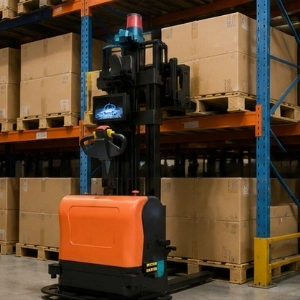
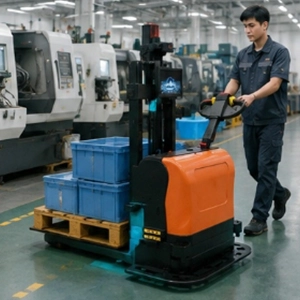
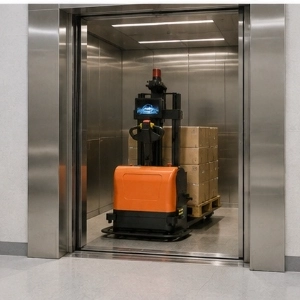
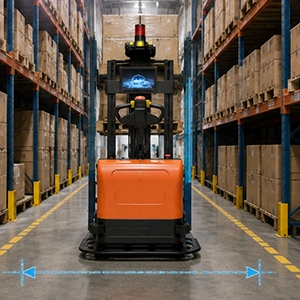
Suitability for a specific application depends on pallet type and condition, floor surface, aisle dimensions, rack configuration, elevator compatibility and operational cycle requirements. A site assessment is recommended before deployment.
Safety System
The integrates a multi-layer safety system designed to monitor the surrounding environment, identify potential hazards and reduce the risk of collisions during autonomous operation.
| Component | Function |
| 60 m LiDAR | Long-range environment scanning and navigation mapping |
| 20 m Obstacle Avoidance LiDAR | Mid-range obstacle detection and path adjustment |
| 3D Pallet Recognition | Pallet position identification and fork alignment |
| TOF Sensor | Close-range depth perception for precision operations |
| Ultrasonic Sensors | Short-range obstacle detection in blind spots |
| Safety Edge | Contact-activated stop upon physical collision |
| Emergency Stop Switch | Immediate halt of all motion and functions |
| Auto / Manual Switch | Toggle between autonomous and manual operation modes |
| Power Switch | Main power control |
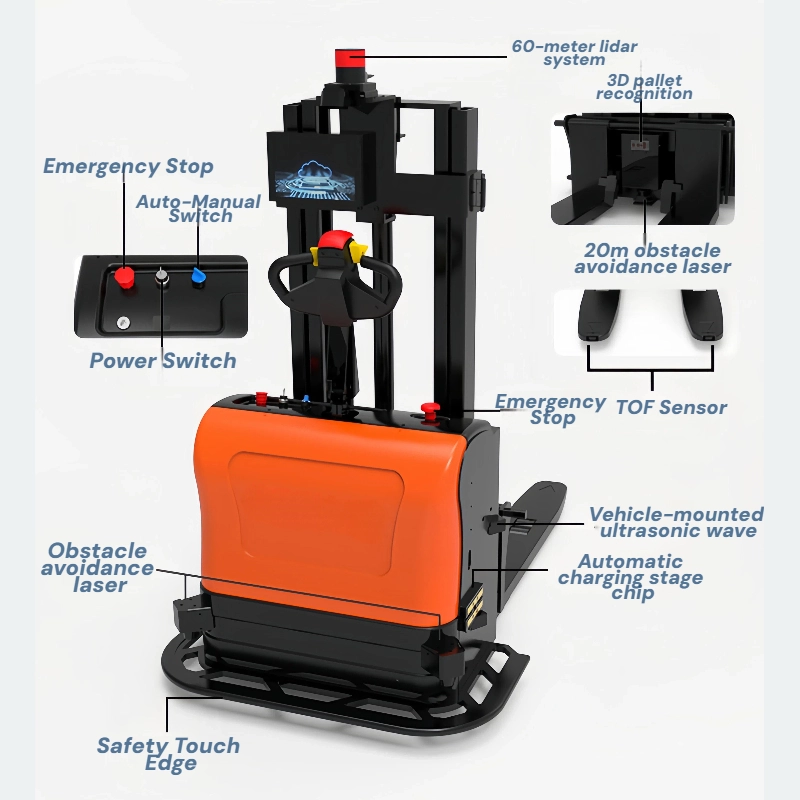
The robot continuously monitors its environment using the combined sensor inputs. When an obstacle is detected, the robot adjusts its path or stops automatically. In manual mode, an operator can drive the robot using the walk-behind controls.
The safety system is designed to support autonomous operation in suitable environments. Site-specific risk assessment and safety validation are required before deployment. The robot’s safety functions do not replace facility-level safety measures, including marked travel paths, pedestrian separation zones and operator training.
Charging & Operation
The uses a 48V battery system with four battery units. See Technical Specifications for full electrical parameters. The robot connects automatically to the movable charging station when battery level reaches the threshold. The charging station features retractable contact plates and can be relocated as operational needs change. No manual battery swap is required during normal operation.
The robot supports two operation modes:
- Autonomous mode — The robot navigates, locates pallets, engages forks, transports loads and returns to charge without operator intervention
- Walk-behind manual mode — An operator drives the robot using manual controls for tasks that require direct human control
The auto/manual switch allows the operator to toggle between modes as needed.
Application Limitations
The following conditions should be evaluated before deploying the RBOT30F:
- Pallet requirements — Pallets must fit within the fork dimensions (1,150 mm length, 685 mm outer width). Pallet condition affects 3D recognition performance. Damaged or deformed pallets may require manual handling.
- Aisle width — Minimum aisle width depends on pallet size and placement orientation. For 800 × 1,200 mm pallets placed along forks, the minimum aisle is 2,100 mm. For 1,000 × 1,200 mm pallets placed across forks, the minimum aisle is 2,200 mm.
- Floor conditions — The robot requires a floor surface suitable for polyurethane wheels. Ground clearance at the axle center is 30 mm. Floor irregularities, ramps and level transitions should be evaluated. Climbing capacity is 8% loaded and 15% unloaded.
- Rack requirements — Maximum lift height is 2,585 mm. The load center distance is 500 mm. Rack dimensions and vertical clearance must accommodate the fork lowest position (85 mm) and max mast height during operation (3,050 mm).
- Elevator compatibility — Cross-floor operation requires compatible elevator controllers and communication setup. Elevator model and control interface must be confirmed before deployment.
- Safety assessment — A site-specific risk assessment is required before autonomous operation. The robot’s safety functions do not replace facility-level safety measures, including marked travel paths, pedestrian separation zones and operator training.
- Navigation environment — Real laser SLAM navigation depends on the environment having sufficient geometric features for LiDAR to reference. Facilities with long featureless walls may require additional mapping support.
Final suitability should be confirmed through a site assessment.
Technology and Specification Guide
FAQS
Q: Can the operate without installing reflectors or magnetic strips on the floor?
Yes. The robot uses real laser SLAM navigation. No reflectors, magnetic strips or QR codes are required. The robot maps the environment using onboard LiDAR and navigates autonomously.
Q: Can the robot travel between different floors?
Yes. The is designed to travel via freight elevator for cross-floor operations. Elevator integration requires compatible elevator controllers and communication setup. Confirm elevator model and control interface before deployment.
Q: What pallet types can the robot handle?
The robot is compatible with standard pallets that fit within the fork dimensions (1,150 mm length, 685 mm outer width). The 3D pallet recognition system adjusts to pallet position and orientation. Pallet condition and entry point accessibility affect recognition performance.
Q: How does the robot charge?
The connects automatically to the movable charging station when battery level reaches the threshold. The charging station features retractable contact plates. No manual battery swap is required. The station can be relocated as operational needs change.
Q: What is the minimum aisle width required?
The minimum aisle width depends on pallet size and placement orientation. For 800 × 1,200 mm pallets placed along forks, the minimum aisle is 2,100 mm. For 1,000 × 1,200 mm pallets placed across forks, the minimum aisle is 2,200 mm. Confirm actual requirements against your pallet dimensions and storage layout.
Q: What warranty and after-sales support is included?
The comes with a 12-month warranty. Lead time is 35 days from order confirmation. MOQ is 1 unit. For after-sales support, contact AIsirRobot with your application details and project requirements.
Request a Quote or Technical Evaluation
Tell us what you need the robot to do. Even if some technical details are not yet confirmed, our team can help evaluate suitable options.
- Application: Briefly describe the task, workflow, or problem you want the robot to handle.
- Key requirements: Share any known payload, reach, capacity, runtime, accuracy, speed, or other performance needs.
- Site & integration: Tell us about the operating environment, layout, existing equipment, or software interfaces if relevant.
- Quantity & timeline: Let us know the expected quantity, destination country, and target delivery or deployment time.